Shared Flavors , Shared Memories
My Story
Every dish has a story. Some foods stay with you because they carry more than flavor. This is my story of how meals became the way I understand family, memory, and who I am.
Every dish has a story. Some foods stay with you because they carry more than flavor. This is my story of how meals became the way I understand family, memory, and who I am.
Whenever my mom and I talk on the phone, she asks the same thing.
"Yojum mwo meokgo sani?" (요즘 뭐 먹고 사니?)
It means: "What are you eating these days?"
But it's never just about food. It's her way of asking how I am. Her way of staying close, even from far away.
She has lived her whole life in Korea, apart from a few rare visits to see me abroad. She sees the world mostly through TV and through the stories I bring home. Over time, food has become the central topic of our conversations. We send each other photos of our meals. I share my joy of discovering good eats with her. She tells me about her seasonal cooking. Through food, we maintain our bond across distance.
One summer while visiting her, I cooked fajitas with homemade tortillas and pico de gallo. I explained that in Mexico, pico de gallo is eaten with almost every meal — just like kimchi in Korea.
The analogy clicked instantly. She couldn't remember the name, but from then on she began calling it Mexico kimchi (멕시코 김치). Of course it isn't kimchi, but the comparison makes sense. Now even her friends know it by that name.
What I love most is how curious she is — always eager to connect what I share with what she knows. It's her way of interpreting the world. Through food.
Every summer around June, she reminds me it's oiji (오이지) season. I tell her about similar pickles I've come across: kovászos uborka in Hungary, kosher dill pickles in the U.S., or my own version using whatever cucumbers I can find. Each time, she's curious, delighted, and full of questions.
As I moved from country to country, I found myself constantly adapting recipes from home with whatever ingredients were available. Sometimes the dishes were familiar but not quite the same. Other times, they became something new altogether. I shared these experiments with my mom, and in explaining them, I started to see how different food cultures overlap. Geography, history, and language lessons I once memorized in school suddenly felt alive — embedded in the food on the table.
Even love found me through food. I met my husband in Taiwan. I remember watching him try everything at a night market — even stinky tofu, which nearly made us both gag, while my Taiwanese colleague ate it like fine cheese.
What impressed me most was his respect toward her and her culture. From him, I learned something simple but lasting: we don't have to like everything, but we can still respect and share in another culture.
That same openness carried into his family. My father-in-law, whom I called Apa — the same word for "Dad" in both Hungarian and Korean (아빠) — connected with me through food and drink. He'd say, "Let's have pálinka," or hand me savanyú káposzta, knowing how much I loved its kimchi-like taste.
And sometimes food speaks without a single word.
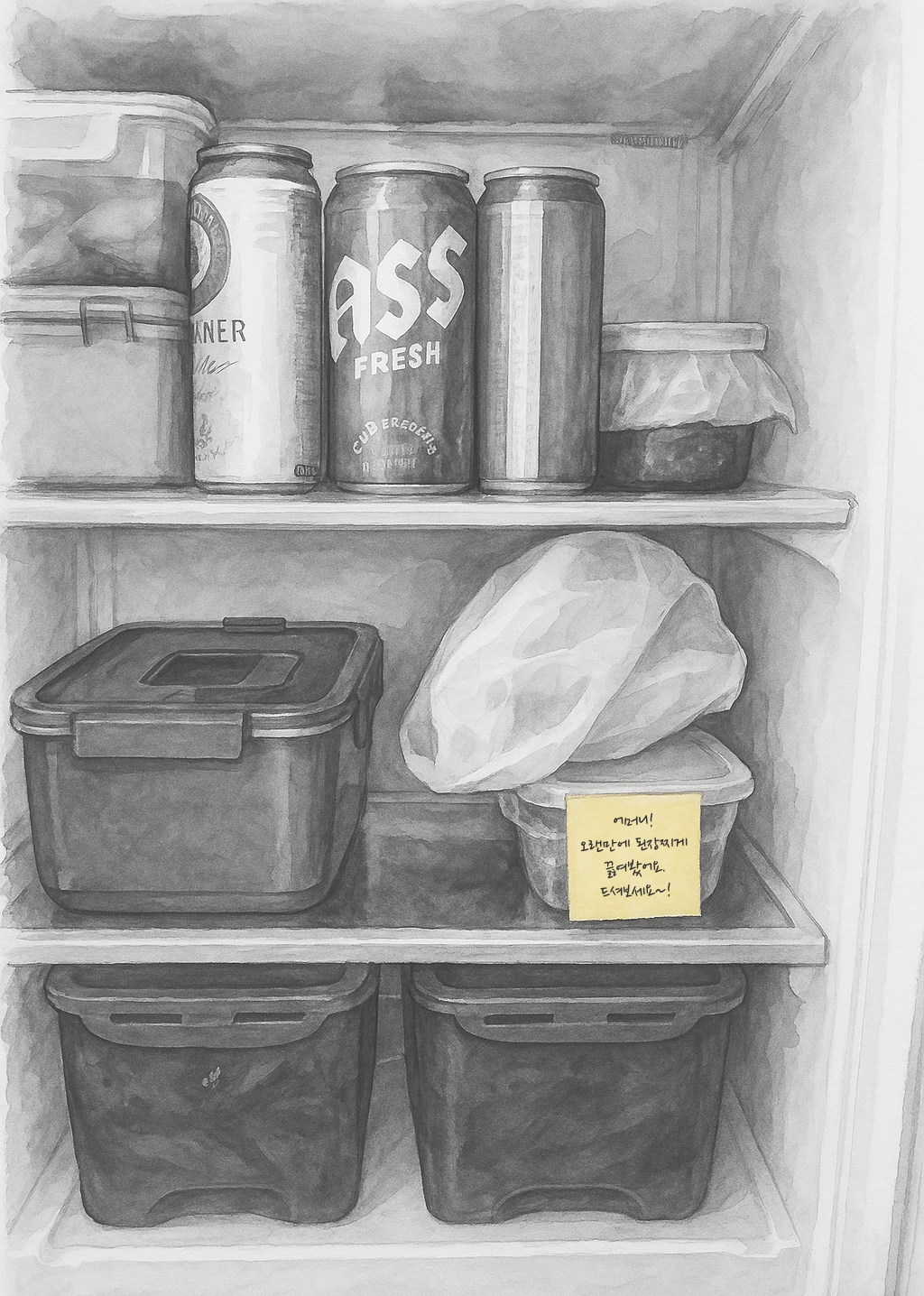
Like my mother-in-law's fridge, stocked with spicy sauces — Erős Pista — even though she can't handle heat at all.
Or the note my sister-in-law left for my mom: "It's been a while since I made this doenjangjjigae (된장찌개), please try~!"
What I think it really meant was: "I'm sorry I haven't had time to invite you for dinner — and thank you for helping with our children."
I want my niece and nephew to grow up knowing what I've learned through all of this: that the world is big, but not as divided as it sometimes seems. That we are connected, not separated. And that food is one of the clearest ways to see it.
That is why I started Flavorful Identity.