Shared Flavors , Shared Memories
Aranygaluska: The One Sweet I Do Not Refuse
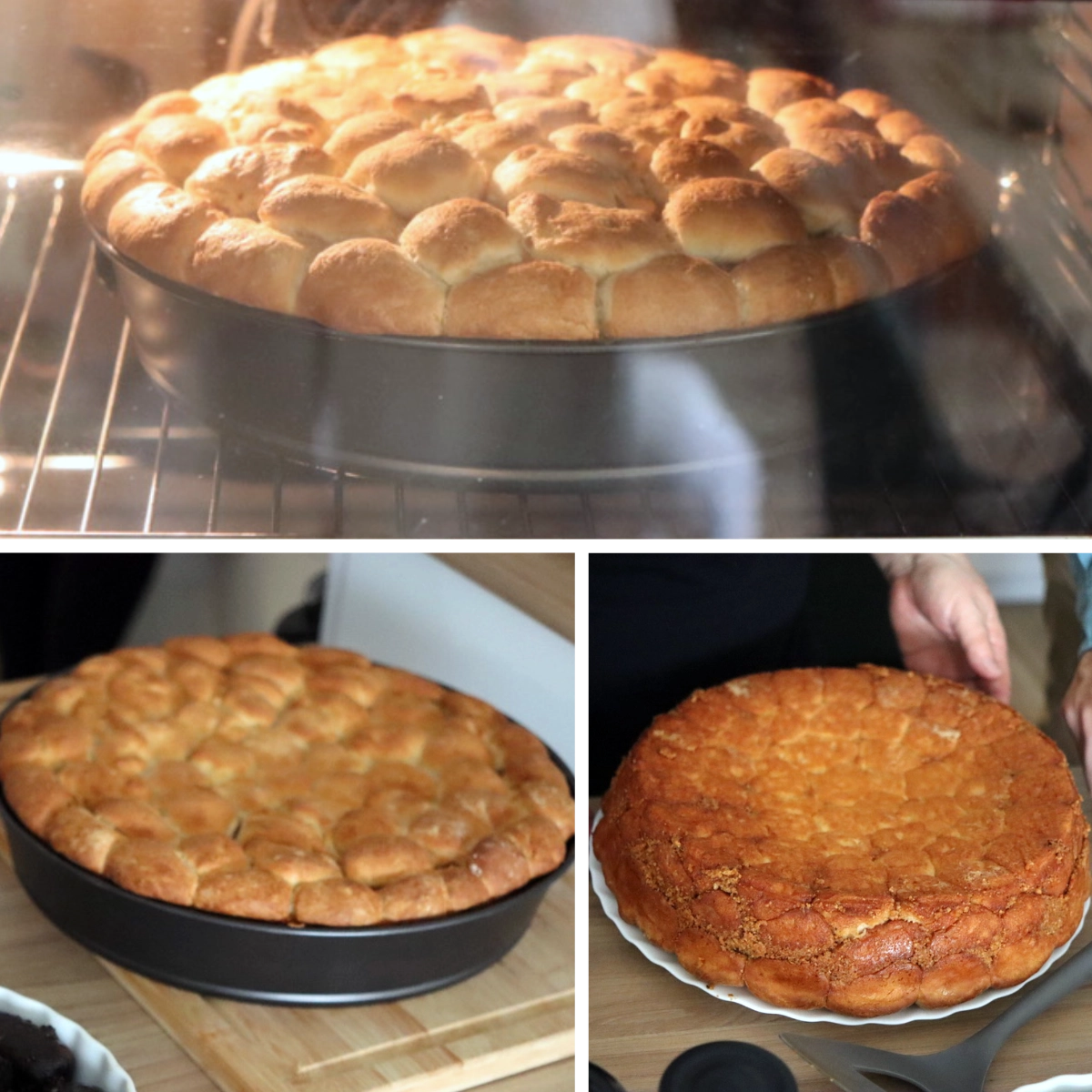
It looks like cake, but it behaves like bread. Aranygaluska is the one sweet that feels grounded rather than indulgent.
It looks like cake, but it behaves like bread. Aranygaluska is the one sweet that feels grounded rather than indulgent.

I do not like sweets. At the end of a family meal, when everyone leaves room for dessert, I do not. I finish with more meat, something savory, something that closes the meal with weight rather than sugar.
Despite this, there is one exception: aranygaluska.
It is sweet, but not excessively so. It resembles a cake in shape but is fundamentally bread. Each piece is coated in sugar and ground walnuts, which add texture and density. The nuts absorb and temper the sweetness, making it feel substantial rather than excessive. Its sweetness does not overwhelm or separate itself from the rest of the meal.
It reminds me of the doneocheu (도너츠) I grew up with in Korea, simple fried yeast dough, coated lightly in sugar. Sometimes uneven in shape and density. Their sweetness was present but didn't dominate. What you noticed was the dough itself: its warmth, elasticity, and weight. Aranygaluska follows the same principle. Although baked rather than fried, it preserves that balance between sweetness and substance.
The name means "golden dumplings." Small balls of enriched yeast dough, rolled in butter and a walnut-sugar coating, baked together in a single dish. The pieces fuse during baking but remain structurally separate, meant to be pulled apart by hand.
Walnut is what makes it distinctly Hungarian. It appears throughout Hungarian desserts: bejgli, a rolled pastry filled with ground walnut paste, and zserbó, layered with walnut and jam. In these desserts, walnut is not decorative. It provides structure, texture, and restraint. It transforms sweetness into something grounded.
In the United States, a similar dish exists as monkey bread, small pieces of yeast dough coated in butter, sugar, and cinnamon, baked together, pulled apart by hand. The same lineage, carried by Central European immigrants. Cinnamon replaces walnut, and the sweetness becomes more pronounced. But the method persists: individual pieces formed by hand, assembled together, baked into a single body.
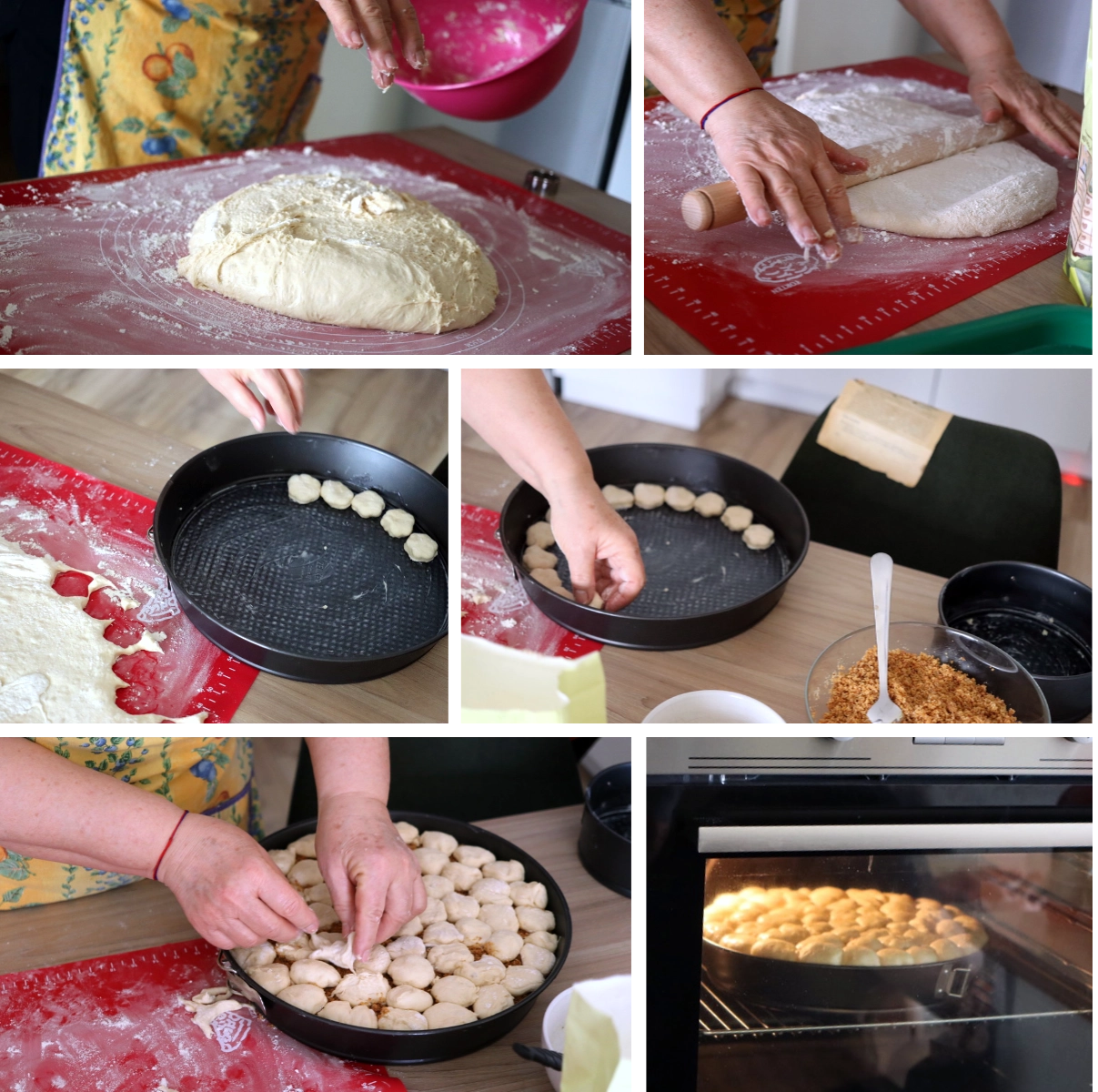
My mother-in-law makes aranygaluska regularly, despite the time and effort required. The dough must rise. Each portion must be formed individually, coated, and arranged carefully before baking. She makes it because she knows I will eat it, even when I refuse other desserts. I am aware of the labor involved.
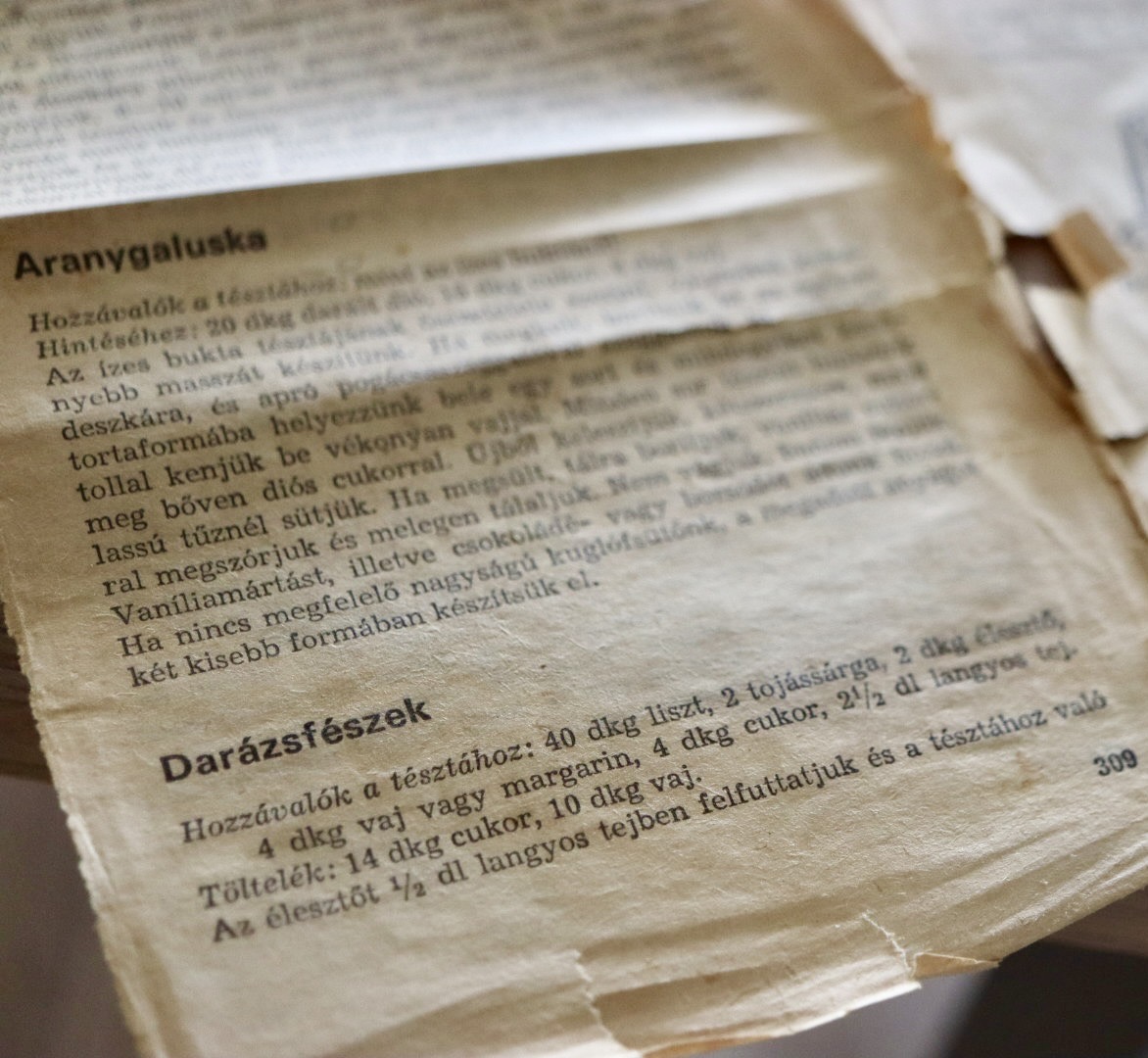
She keeps her recipe on a single sheet of paper torn from an old book. The edges are worn and uneven. The paper has darkened with age. She does not consult alternative versions or adapt it. She continues to use the same recipe, unchanged.
I once photographed her while she was making it. The process unfolds slowly. The dough rests, expands, is shaped into small balls, each coated and placed carefully into the baking dish. The pieces are not uniform, and their differences remain visible in the finished form. That unevenness is part of its beauty. It is shaped by hand, not by mold.
We make it at Christmas, alongside zserbó. These foods appear at specific times, not as novelty but as continuation. They are not introduced or explained. They are repeated.
My preference for aranygaluska does not contradict my dislike of sweets. What I recognize in it is not sweetness alone, but continuity. The dough, the walnut, the worn recipe page, the labor required to produce it. It remains the one sweet I do not refuse, not only because it is good, but because it carries the record of its own making.