Shared Flavors , Shared Memories
What We Carry Home
I showed up at a gisa-sikdang in Yeonnam-dong with my own Tupperware. The grandmother looked at my containers the way you look at something that reminds you of a different time.
I showed up at a gisa-sikdang in Yeonnam-dong with my own Tupperware. The grandmother looked at my containers the way you look at something that reminds you of a different time.

Near my place in Yeonnam-dong there was a small alley with several gisa-sikdang (기사식당) clustered together, the kind of neighborhood diner that originally catered to taxi and bus drivers needing quick, filling meals between shifts. Not a famous street, just a quiet pocket of ordinary restaurants. Whenever I craved jipbap (집밥)taste of a home-cooked meal, I would stop by one of them for takeaway.
One day I showed up with my own Tupperware: one container for bap (밥), a few small ones for banchan (반찬), another for jjigae (찌개). The grandmother running the place noticed them immediately. These were proper plastic containers, bright and new, unlike the tubs most people reused as banchantong, the familiar red containers that once held gochujang, or the green ones for doenjang, often still bearing their original labels.
She looked at them for a moment, then smiled.
"아이고, 이렇게 이쁜 그릇을 가져왔어."
"Oh my, what pretty containers you brought."
She used the word geureut (그릇), the everyday Korean word for dishes and food containers, as if these plastic boxes deserved the same name as proper tableware.
Watching a young student hand over such neat containers, she seemed almost wistful, as if something as ordinary as a new piece of kitchenware could briefly remind you of a different time. She filled them generously. Enough food to last me the entire week.
At my grandmother's house, food was stored in stainless steel containers she called seudaeng (스댕), a colloquial shortening of "stainless." They were sturdy and permanent-feeling, the kind of kitchenware that seemed like it would outlast everything else in the kitchen. The lids clanged when they closed. If you dropped one, the floor complained before the container did.
To her generation, plastic containers must have seemed almost futuristic. Light, transparent...You could see the rice, the banchan, the soup inside without opening the lid. They sealed tightly enough that you could carry kimchi without worrying about leaks. The word Tupperware became a generic term for any plastic food container, the way some brand names absorb their entire category. I still catch myself using it that way.

But for a long time many households didn't buy containers at all. They reused whatever came with food. Empty gochujang or doenjang tubs were too useful to discard. Plastic sauce jars became storage for leftovers. At small rural markets you might still find someone selling chamgireum (참기름) in a reused soju bottle. Sesame oil pressed nearby, poured into whatever bottle was clean and available. When something was still perfectly usable, throwing it away was simply not a thought that occurred.
Years later, a friend in Hungary told me about his grandmother, who packed leftover food for him to take home in empty ice cream tubs. When the family ran out of containers, they would sometimes buy a bucket of ice cream at the supermarket specifically to have something to pack food into. I found that detail strangely charming: the container as reason enough, the ice cream almost incidental.
Sunday lunches at my in-laws' house follow a similar pattern. There is always more food than we can finish. When we leave, someone hands us a container. A portion of the weekend meal quietly becomes weekday food in a box. I never really had that experience living far from my own family. Perhaps that's why these gestures stay with me.
In Korea, food travels this way too. Mothers send daughters home with containers of kimchi, sometimes several kimchitong (김치통) packed with different varieties. That is what my grandmother did for my mother, sending her home with boxes that would last for weeks. The containers carried more than food.
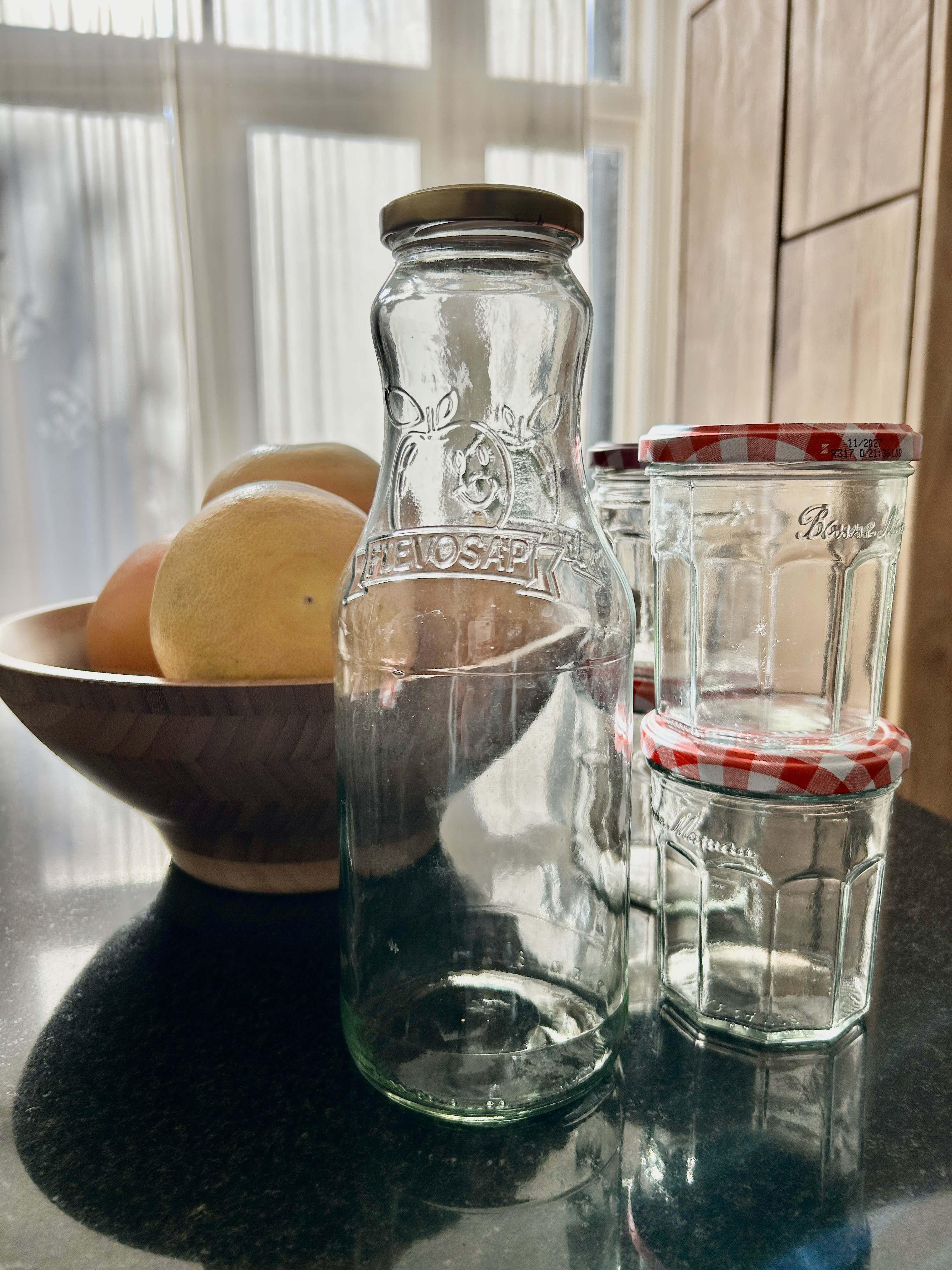
Now I notice the same habit appearing in my own kitchen. I reuse jam jars to pack a little kimchi for friends. I keep empty apple juice bottles and refill them with freshly squeezed juice. Jelly jars collect on the shelf because I like the way they look, glass clear and solid in the hand, and they end up holding small batches of jangajji (장아찌), vegetables slowly soaking in soy sauce and vinegar.
Sometimes I see them lined up and think back to that grandmother in Yeonnam-dong, the way she looked at my bright new containers. At the time I thought I was simply bringing something to pack my food into. Only later did I understand what she recognised in them, and what I have slowly learned to recognise too. Food packed for someone to take home carries its own kind of insim (인심), a generosity that needs no explanation. The containers keep changing. The habit doesn't.