Much of today’s food arrives almost finished. Factories prepare it, appliances complete it, and we perform the final step. In that small gesture between machine and meal, a new kind of cooking has emerged.

When the microwave first came into our home, my brother and I were excited. It claimed we could make ramyeon (라면) with it. Unbelievable! We unpackaged the ramyeon, placed it in a ttukbaegi (뚝배기), poured in water, and added the powdered soup base. Worried it might explode, we hid behind the dining table and watched the bowl slowly rotate behind the glass door. Four minutes felt long. The hum of the machine sounded mechanical and distant, but when it finally stopped, we were amazed.
We had discovered another way to make ramyeon—machine-assisted and much safer than using a gas stove. It was not cooking in the traditional sense, but it still felt like a small victory. The microwave marked an important shift, reducing cooking to the act of pressing a button. You no longer needed to know how to simmer soup or steam rice. All you needed was electricity and a few minutes of patience. For students, children, and busy workers, this meant independence. Cooking became less about skill and more about access.
Soon, having a meal became almost effortless. With the widespread presence of baptong (밥통), the rice cooker that keeps rice warm throughout the day, dinner could be assembled in minutes. All you needed to do was open a pouch of sam-bun kare (3분 카레), a popular retort Korean style curry named for the three minutes it takes to heat the pouch in boiling water, pour it over rice, and karelaiseu (카레라이스) was ready.
Retort food (레토르트식품) in pouches like sam-bun kare (3분 카레) or sam-bun jjajang (3분 짜장) became popular in Korea not only because microwaves were common, but because it matched how meals were structured. A proper meal is expected to be served hot. Rice arrives steaming. Soup is ladled warm. Soups like yukgaejang (육개장) or seolleongtang (설렁탕), dishes that traditionally required hours of simmering could now appear in a pouch. The long simmering had already happened elsewhere, but the structure of the meal remained unchanged.

Convenience reshaped dinner as well. Many grocery-store meals now sit between raw and finished. They are designed to be almost ready, requiring only a few minutes in the microwave. A ready-to-cook meal kit replaces chopping and simmering. Much of the work happens before the food reaches the store. Factories perform the preparation, appliances complete the transformation, and we activate the final step.
These systems also assume smaller households. Many of the foods appear in single portions, practical for people living alone, for whom cooking large quantities no longer makes sense. Instant rice, sold under brands like Haetban (햇반), reinforced this shift. Traditionally, rice stayed warm in a rice cooker throughout the day. As more people began living alone, keeping a full pot no longer felt practical, yet the expectation of hot rice remained. A single portion could now be heated in minutes and served alongside a retort dish.
The microwave also changed where food could be eaten. In some places it made meals more mobile. In the United States, products like Hot Pockets were designed for that purpose: heat, wrap, and go. I used to microwave one and eat it while driving. The car became the dining space, and the microwave turned breakfast into something portable.
In Korea and other dense Asian cities, however, the same technology often leads to a different rhythm. Convenience food still moves quickly, but it invites a short pause rather than constant motion. Places like pyeonuijeom (편의점), open late into the night and stocked from floor to ceiling, become warm stops between the subway and home. Microwaves stand side by side, ready to heat whatever you have picked up. The food is quick, but it is meant to be eaten there — standing at a counter or sitting briefly by the window with a bowl in your hands.
The irony is that the microwave enables both habits. In one place it turns food into something portable. In another, it becomes the reason to stop for a moment and eat something warm. What becomes clear is that the appliance shapes everyday habit. In my own kitchen, the microwave has become one of the most-used tools.
I use the microwave far more than I expected I would. Some people criticize it, citing health concerns or claiming it ruins texture. I understand the hesitation, but for me the microwave is practical. It heats food quickly and evenly, without requiring supervision. It does more than reheat leftovers. I cook vegetables with it. Cabbage, in particular, takes seven or eight minutes before it is ready to use as ssam (쌈). What once required steaming or boiling now happens quietly behind a glass door.
In many Korean households, the microwave stretches beyond reheating. People make microwaved cakes in mugs. There are even plastic vessels designed specifically for spaghetti, long enough to fit the noodles so they can cook directly in the microwave. The appliance becomes something close to an oven, not because it was designed that way, but because people learned how to adapt it.
The microwave’s popularity was never only about speed. It was about versatility. It allowed ordinary kitchens to do more with less space, less heat, and less time.

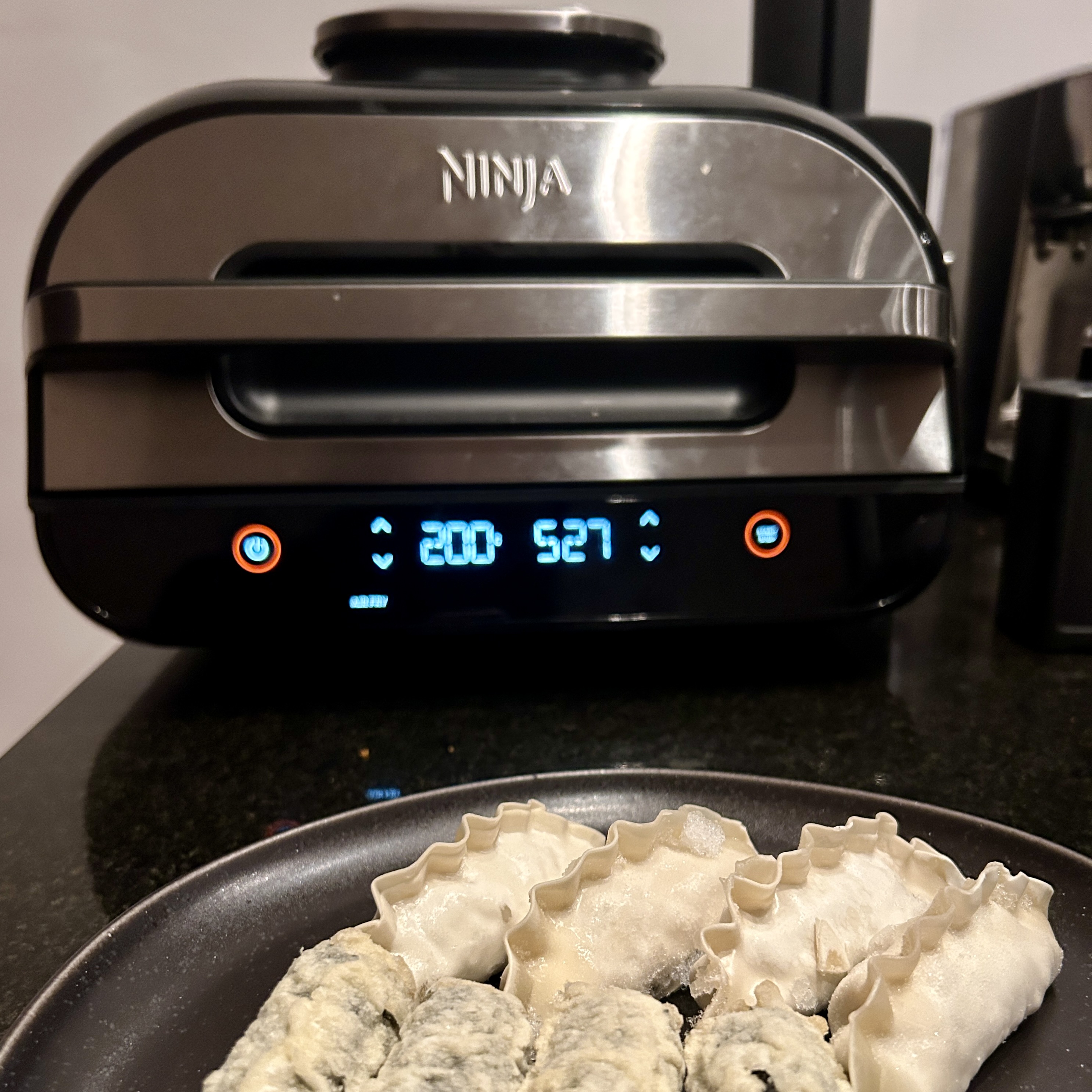
If the microwave emphasized speed, the air fryer restored texture. Meals that once emerged soft or slightly soggy from the microwave regained crisp edges and structure. The air fryer brought back crispness—a quality we associate with freshness and care. Frozen dumplings could turn golden. Fried chicken regained its crunch. Texture carries emotional weight. Browning suggests attention.
Korean kitchens traditionally did not revolve around ovens. Baking was never central to everyday cooking. Rice was steamed, soups simmered, and meat grilled or pan-fried. Bread was usually purchased rather than baked at home. The oven remained peripheral—large and slow compared to daily habits.
The air fryer, however, fit immediately. It was compact, fast, and contained. It did not require adopting a baking culture. Instead, it amplified something already valued: crunch. In Korean, the expression geot-ba-sok-chok (겉바속촉) describes food that is crisp on the outside and tender inside. The word basak-basak (바삭바삭) imitates the sound of crunch. Texture signals freshness and care.
Frozen foods rose alongside it: fries and fried chicken, known in Korea as gamtwui (감튀) and chikin (치킨). Foods that once risked turning soggy in a microwave regained crisp edges and surface structure. The technology aligned with existing preferences rather than introducing foreign habits.
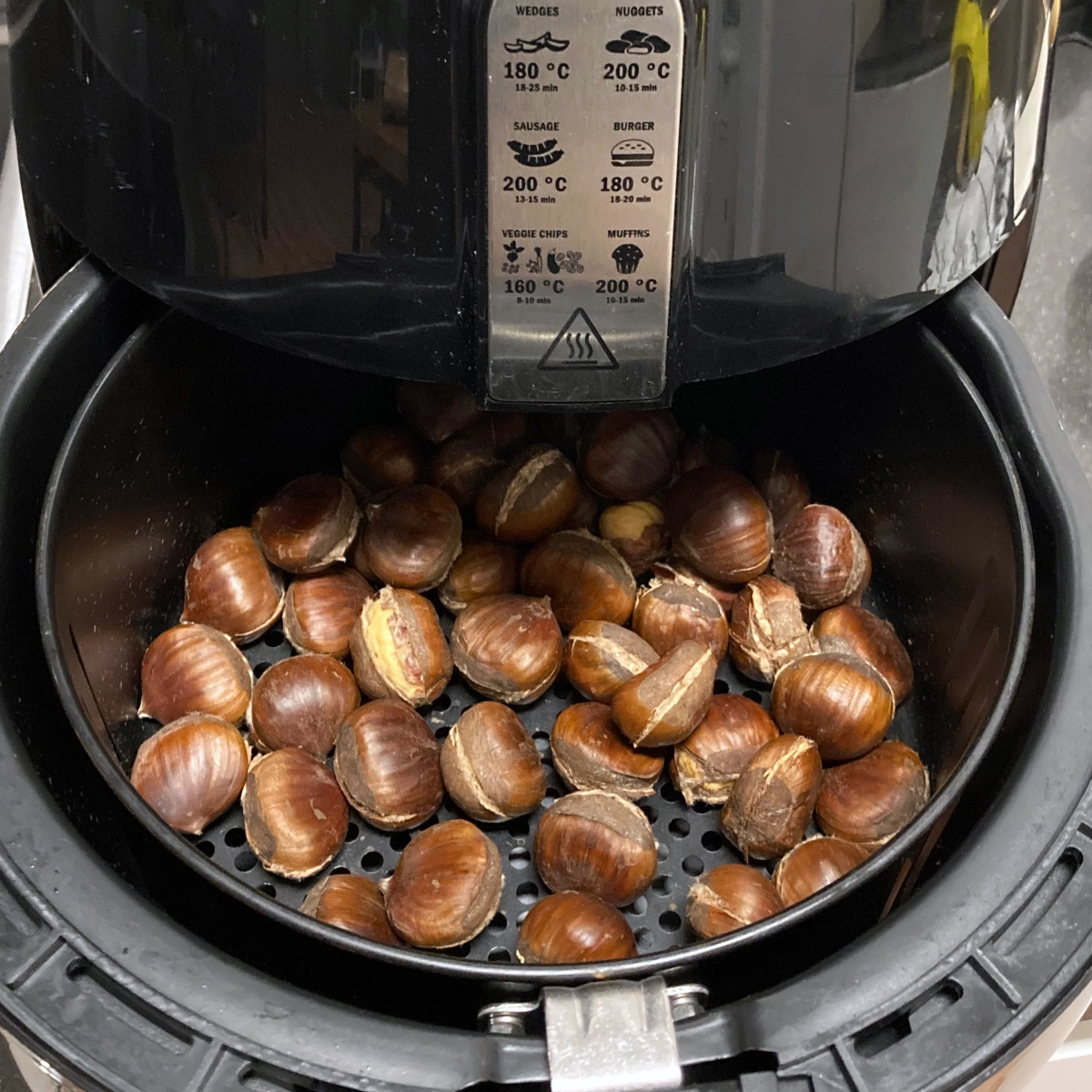
As a result, the air fryer began to take on roles beyond reheating frozen food. People started using it for things that once required charcoal, oil, or careful stovetop attention. Gun-goguma (군고구마), gunbam (군밤), and even gun-gyeran (군계란) could be made at home with little effort. Some cook samgyupsal (삼겹살) in it, while others bake small loaves or simple breads.
Recipes circulate widely online, and experimentation continues. Cheese also appears in unexpected places. On kimchi bokkeumbap (김치볶음밥), mozzarella is melted until the edges brown and form a crisp layer where cheese and rice meet. The air fryer encourages this texture, browning surfaces and giving familiar dishes a slightly different finish.

One detail keeps standing out to me. If efficiency were the only goal, food could arrive fully prepared and ready to eat. Yet many modern foods stop just short of that point. They are cooked enough to travel well, stable enough to sit on shelves, but unfinished enough to be completed at home. This halfway state makes them easier to circulate through factories, warehouses, and stores while still allowing the final step to happen in the kitchen.
Pressing a microwave button, waiting for an air fryer cycle — these gestures complete the process. Even minimal effort creates a sense of involvement. Food feels different when it passes briefly through our hands. People often say ramyeon tastes better when someone else makes it, even if the difference is subtle.
Cooking was once a continuous process—from raw ingredients to finished meal. Now it has been divided across systems. Industrial kitchens handle preparation. Household appliances complete the transformation. We perform the final step. Semi-cooked food doesn't eliminate cooking; it redistributes it. And in that redistribution, the feeling of cooking persists.
At home now, I use the air fryer for things I once associated with oil and supervision: bitterballen, kroket, fries, fried chicken. I no longer need to order fried chicken for delivery because there is always a box in my freezer, ready whenever I want it. Ten minutes in the air fryer and it comes out crisp, sometimes even crispier than what arrives in a cardboard box.
Yet I find myself thinking about how fried chicken used to arrive in Korea when we were little. After placing the order by phone, we would wait, sometimes half an hour, sometimes longer, without knowing exactly where the delivery motorcycle was. There was anticipation in that uncertainty. I would listen for the engine outside, then for the doorbell. When it rang, I would hurry to the door to receive the warm bag, slightly oily at the bottom, heavy in my hands.
The waiting once stretched the excitement. Now I expect it in ten minutes or less. The machine hums while I stand nearby. It is efficient and reliable, and the texture is crisp, yet the rhythm feels different. What I miss is not the flavor, but the anticipation that came with that pause. Food arriving after that pause carried a kind of presence that instant preparation cannot reproduce.