Shared Flavors , Shared Memories
Before I Tasted It
Some foods take a friend's confidence to try. Some take a war. Some need nothing at all, you've already crossed that line without noticing.
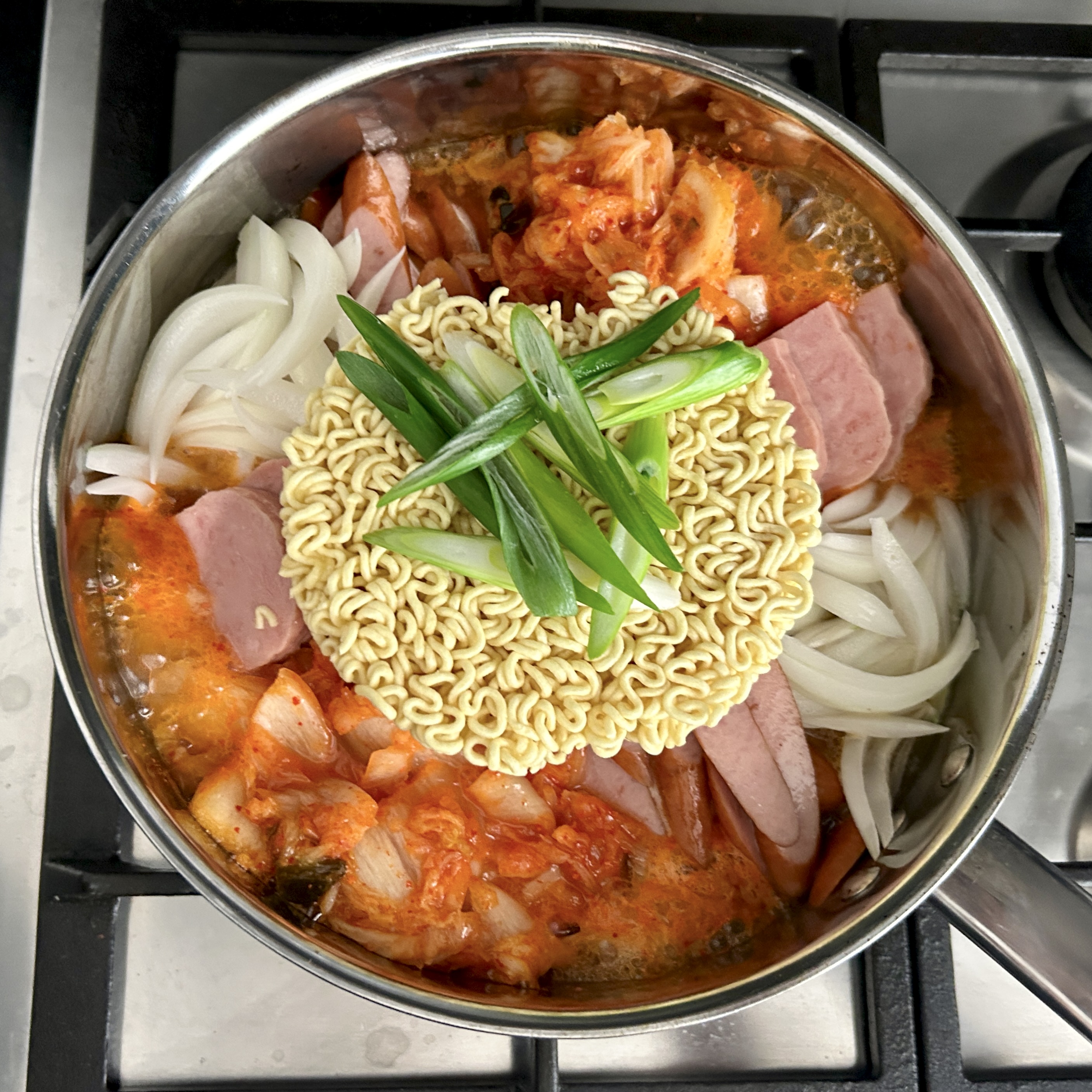
Some foods take a friend's confidence to try. Some take a war. Some need nothing at all, you've already crossed that line without noticing.

In high school, a group of us girls used to gather on Saturdays, cooking together, chatting in between, the most interesting part of my school life outside of school. By then, we were old enough to have mastered a trick or two, just enough to show off a little. We'd take turns leading the cooking and hosting. The menu that day was gochujang spaghetti, an idea from a friend who'd already tried it somewhere and loved it. We decided to give it a try.
Still, in the back of my mind, I had trouble picturing it. Spaghetti, back then, was almost always tomato-based ragu, a term I learned much later. It was Western food, foreign food, meaning not Korean, the kind you only ate in a place like in a resturant, with a fork you normally didn't use at home. It signaled a special occasion, unlike the ordinary, everyday gochujang tteokbokki you could find anywhere, anytime. They belonged to two different worlds. You weren't supposed to mix them.
We probably threw in some kimchi too. Gochujang for sure. Some ground meat as well. Nothing about how we made it was fancy. It came together in a pan and went straight onto the table, and we ate it right out of the pan, with chopsticks. Spicy, garlicky, slightly sweet. It was good. The whole pot was gone in no time.
Honestly, once I tasted it, there was nothing strange about it. In some ways it reminded me of a meat sauce pasta. In others it resembled tteokbokki. It was all in my head before I ate it. If someone had described it simply as thick noodles in a spicy, savory, slightly sweet sauce, I probably wouldn't have hesitated. But the word "spaghetti" came with one set of expectations, and "gochujang" came with another. Before tasting it, I was reacting less to the food itself than to the labels in my head. All it took was someone else's confidence to get me past them.
I realize I’ve become the one, introducing some of my all-time favorites, like budae-jjigae (부대찌개), to a friend who’s never had it. I grew up eating it as a child, long before I had opinions about anything. What’s natural to me can sometimes be daunting to explain to someone who’s not familiar with it: to most Americans, hot dogs make more sense in a bun. Hot dogs in a soup? Not so much. But sometimes, all it takes is a little confidence from me, saying, “It’s one of my favorites. I love it. You should try it, too,” just like my friend in high school did with gochujang spaghetti. I’ll talk whoever I’m with into ordering it. I’ve done it many times because it’s my personal favorite (and it usually requires a minimum order of two).
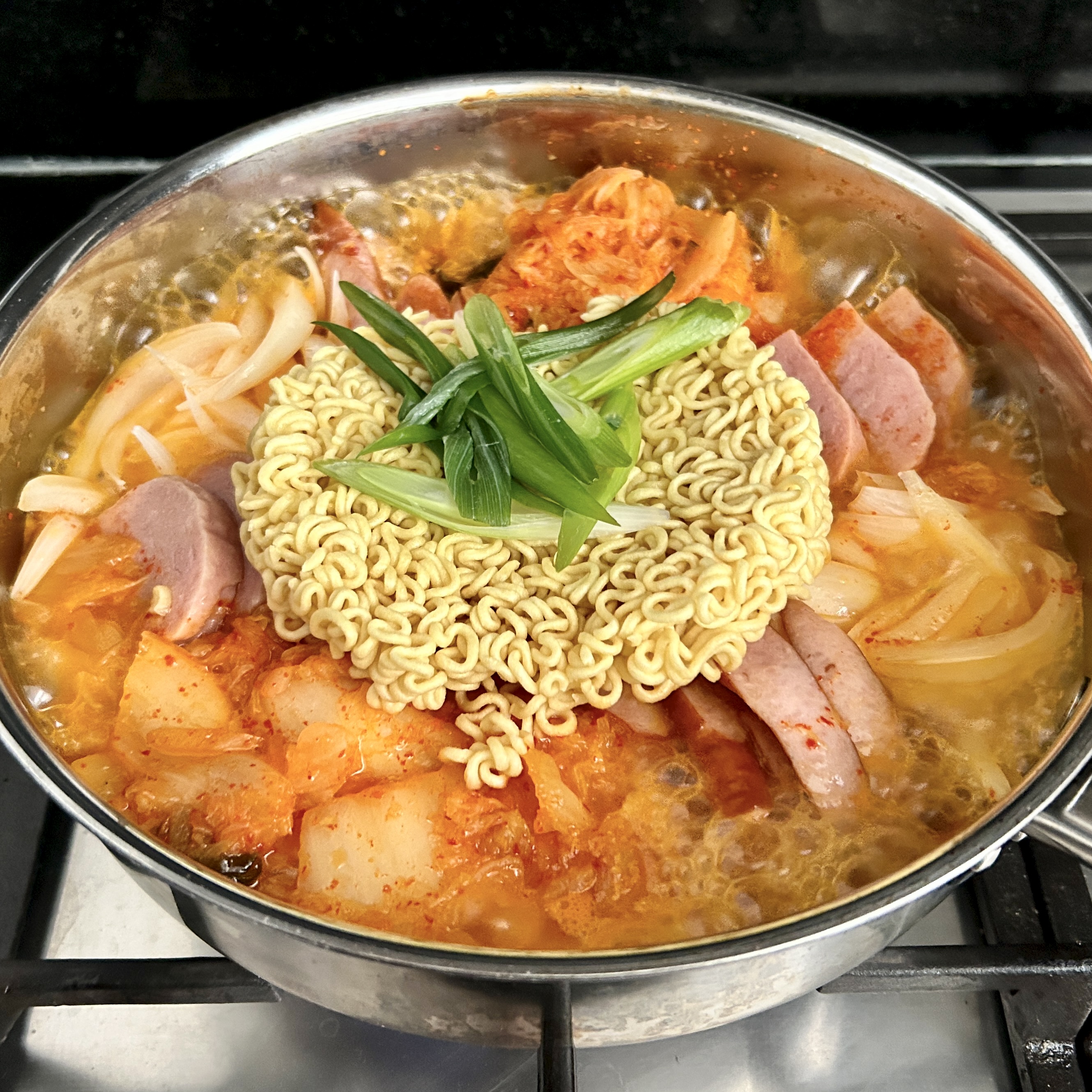
Anyhow, whoever first came up with budae-jjigae was a genius in my opinion, though I don’t think they had the luxury of choice at all. And I wonder if anyone could have come up with those combinations without the circumstances that made it. Discarded, processed meat from a military base. Kimchi added, maybe to Koreanize the taste, maybe to cut through the richness, maybe just because it was there. No one had to be talked into it. The war did that.
I grew up eating the “original version” in the budae-jjigae golmok in Uijeongbu, supposedly the birthplace of budae-jjigae, where dozens of restaurants sold the same thing, each claiming to be the original, with photos of the grandma on the signage who supposedly started it all. Dining out there was a rare perk of visiting my aunt (the oldest of seven siblings, six really, since one was lost during the Korean War). It was more than an hour away by bus, which I hated; I got motion sick, and the bus was the only way there, stopping constantly along the route, dropping people off, picking new ones up. The trick to keep the nausea down was ojingeo (오징어), dried squid roasted at the bus terminal, still my all time favorite.
Odengjib is the name I remember, literally fish cake house, though I'm not sure how that name stuck to a budae-jjigae place. Maybe they sold odeng (오뎅) first, before the jjigae came along. The place had been run by the same family for generations, as far as I know. Each table had its own portable gas burner. They'd bring out the pot already assembled, ready to pour the broth over just before turning on the burner: kimchi stacked in, dark orange from long aging, probably mukeunji; spam, thinly sliced; hot dogs sliced diagonally so they had more contact with the broth (which I only realized much later was the whole point). Some clusters of cooked ground beef too, or so it looked to me back then, the kind most Koreans might call “American ground beef,” though I’ve since learned it’s actually a cheap cut of breakfast sausage, and many people back home still have no idea what it really is. Then the highlight: ramyeon sari on top, technically optional and extra cost, though I don’t think I ever saw a table skip it.
They tell you not to open the lid. All eyes on the pot as it comes to a boil. The quietest moment of the meal, in every sense: no one's talking, everyone's just watching, waiting, until it's finally ready to eat. I couldn't tell you exactly what made it so good. Salty, fatty, sour, and honestly too much sodium. You might suffer a little after, but it was totally worth it, every sip of the broth down to the bottom. Somehow, it all made perfect sense in your mouth, even to our young palates.
I thought all of this was uniquely Korean, such unlikely ingredients married together that I never thought anyone else would have reached the same conclusion, that it could taste this good. That is, until I had an unexpected encounter in Hungary. Virsli, the Hungarian version of hot dogs, in soup: frankfurti leves. Not a dish anyone makes a fuss over, a quick soup, virsli, savanyú káposzta and red paprika powder, nothing that counts as real cooking in my mother-in-law's eyes. I caught her making a bowl of it for herself once, something fast between other things. One taste and I knew exactly what it was: budae-jjigae's cousin. I didn't need to be talked into it. I already knew this flavor logic by heart.

These days, gochujang shows up everywhere, on menus that have nothing to do with Korea. Type “gochujang” into my NYTimes Cooking app, and I see so many recipes associated with it: gochujang caramel cookies, gochujang buttered noodles, gochujang burgers. It has become a trendy ingredient.
Kimchi has joined the trend too. My husband picks up on this faster than I do. He'll come home with something new because he saw it and thought of me: a kimchi croissant from a bakery he happened to pass, a red napa cabbage he found once at Albert Heijn for a few short weeks before it vanished for good, a bag of kimchi-flavored chips. He doesn't need the years I need to be ready; he just tries it.
My very first encounter, gochujang spaghetti, took a friend's confidence. Budae-jjigae took a war. Frankfurti leves took nothing because my lifetime of eating budae-jjigae had already done the convincing. Kids these days are growing up eating these fusions as if they were always normal. If there was never a boundary, there is nothing to cross.
A kimchi croissant just takes a bakery deciding to try it, and my husband picking one up for me to try on a random Tuesday morning. I tried the kimchi croissant. Honestly, not that great. But it's out there, evolving, whether or not it's good yet. That's part of the evolution too, I think. Not a bad thing.