Shared Flavors , Shared Memories
 Fried Dough and the Shape of a Season

Fried dough arrives at different moments of the year. In winter streets, at carnival’s end, in office kitchens, and in markets, it carries timing as much as taste.

Winter Streets and a Paper Bag

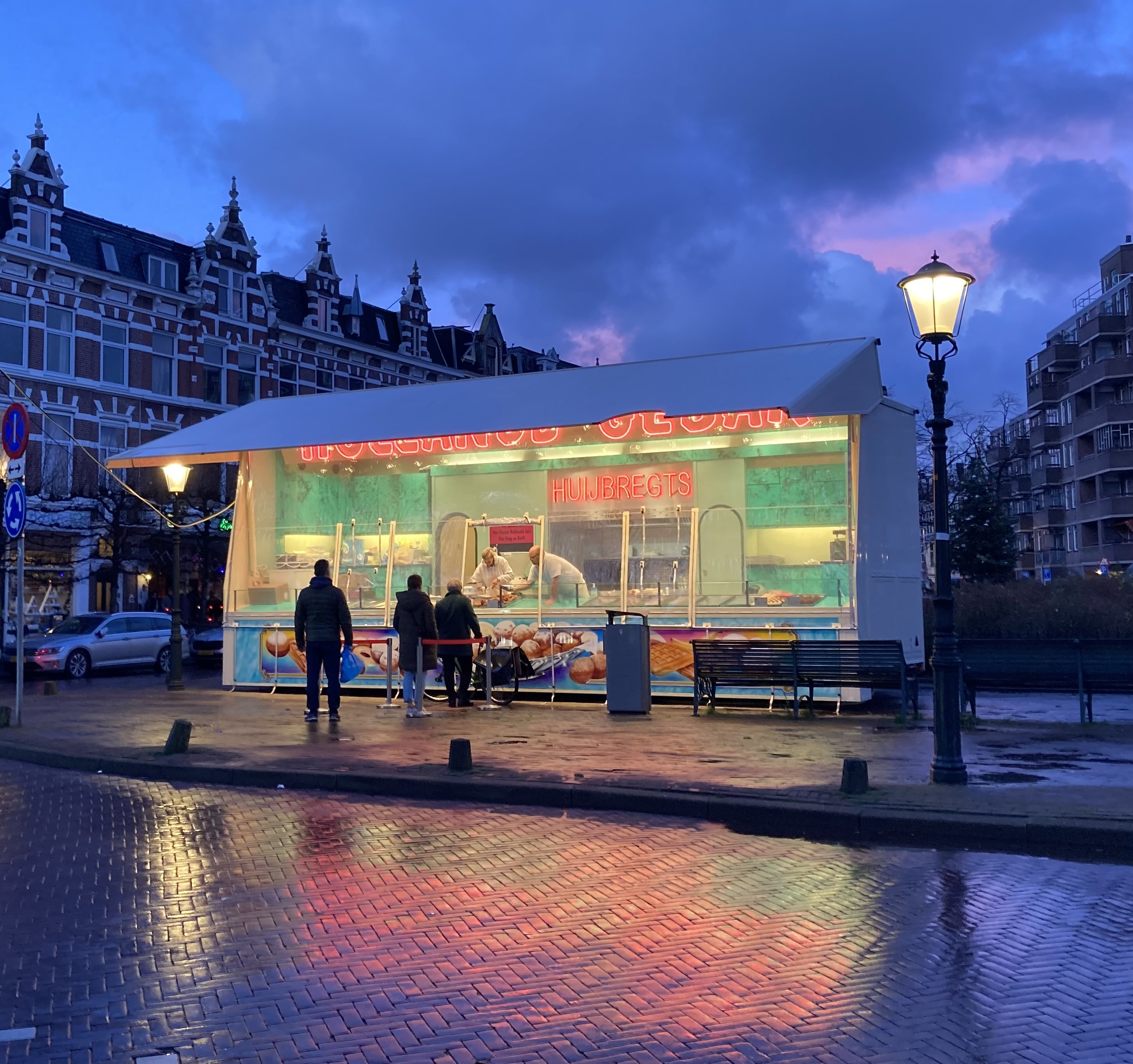
My first winter in the Netherlands felt darker than I expected. As the days shortened, small stands began appearing across the city — bright, almost theatrical, their windows stacked high with golden fried dough. At first, they looked like circus tents dropped into ordinary streets. People stopped on their way home, buying one to eat while walking or carrying a small paper bag back to the train.

I didn’t think much about it at first. It simply felt like winter had arrived. But after that first year, I began to expect it. Even though I never grew to love the cold, windy Dutch weather, I started looking forward to this moment. The stands felt like a quiet signal that something brighter was coming. Soon there would be Christmas markets, lights strung across streets, people standing outside in scarves and gloves, holding warm oliebollen in one hand and coffee or tea in the other. The air stayed cold, but the city felt warmer. There was an excitement I couldn’t fully explain, a sense that winter carried its own kind of glow.

Oliebollen, After Midnight

The first time I ate oliebollen on New Year’s Eve, it wasn’t at a market stand. It was after midnight. The clock struck twelve. There was a toast, quick hugs and kisses, and then we stood by the window watching fireworks scatter across the neighborhood sky. It was loud and chaotic, each street setting off its own celebration, one of the last years individual fireworks would be allowed before restrictions came.

While the fireworks continued outside, we ate oliebollen indoors, still warm, along with appelbeignet, a battered slice of apple fried until golden. The sweetness felt steady and grounding after the noise. The night was cold, but the room was warm, and the ritual felt contained and deliberate.

It marked the beginning of the year — a promise of good fortune, wealth, and warmth for the months ahead, or simply a family tradition handed down through generations. They belonged to that moment. The new year did not begin without them.

Only later did I understand how closely oliebollen were tied to this season. The stands appear only in winter. They vanish once the cold lifts. Their disappearance is part of their meaning.

Fánk and the End of Winter

In Hungary, fried dough belonged to another moment in the calendar.

I had eaten fánk many times without thinking much about it. My mother-in-law would make stacks of them, soft and golden, dusted with powdered sugar. They felt generous, abundant. I accepted them simply as dessert.

It wasn’t until recently, at the end of February when the air was still cold but beginning to soften, that I understood more. My husband said casually, "We need to chase away winter." I asked what he meant. He explained that this was carnival season, the final stretch before spring, when fánk traditionally appears. “It’s time to eat some fánk,” he said, as if the season itself had issued the instruction.

I hadn’t realized there was a formal celebration to welcome spring, one in which fánk had its place. In Hungary, the Busójárás festival in Mohács marks the symbolic driving away of winter. Masked figures, noise, and procession fill the streets. The scale surprised me. It is not a small custom, but a nationally recognized tradition, inscribed on UNESCO’s Intangible Cultural Heritage list. Fánk belongs to that calendar. It arrives with purpose.

I had eaten the dough before. I just hadn’t understood the timing.

In the Netherlands, oliebollen marks the turning of the year at winter’s coldest point. In Hungary, fánk appears as winter loosens its grip. One belongs to the depth of winter, the other to its release.

A large plate piled high with golden Hungarian doughnuts (fánk), dusted generously with powdered sugar.
Fánk. Hungarian donuts my mother-in-law made. Two full plates for the four of us. Photo by the author

America: Donuts Before Work

I had seen American doughnuts everywhere, but it was in the office that I first understood their role. It felt surprisingly sweet, not only in taste but in the gesture itself. Someone brought a box in the morning, set it on the table, and suddenly people gathered around, coffee in hand, talking before the day properly began.

In the United States, donuts feel less tied to season or ritual and more connected to pace.  They show up early in the morning in office kitchens, at gas stations, on meeting tables, the box opened almost as soon as it is set down. Someone brings donuts, coffee appears, and the day begins.

Part of their role comes from how easily they fit into American routines. They are fast, convenient, and endlessly available. Unlike the winter stands in the Netherlands or the seasonal appearance of fánk, American donuts do not wait for a specific moment in the calendar. They are designed for movement — something picked up on the way to work, shared between tasks, eaten without ceremony.

If European fried dough felt seasonal, the American donut felt perpetually in motion, shaped by speed, convenience, and the quiet habit of sharing something simple and sweet. With a large cup of coffee, it was enough to wake you up and get moving.

Interior of an American donut shop with a chalkboard menu listing single, half dozen, and dozen prices above shelves of donuts, highlighting the boxed quantities meant for sharing.
American donut shop — donuts sold by the half dozen or dozen, boxed up to take and share. Photo by the author

Markets and Everyday Dough

Unlike the seasonal dough of Europe or the routine donuts of American offices, my childhood memory of fried dough comes from the market. Going with my mother, receiving something sweet and warm almost as a bonus, that small reward after errands were done. The Korean versions I liked most were made from sticky rice dough, chapssal donuts (찹쌀도너츠), sometimes filled with red bean paste. They were soft and chewy rather than airy. There was also a twisted variation called kkwabaegi (꽈배기), dusted with coarse sugar. Simple, uneven, not made to impress.

They carried no obvious seasonal meaning. Nobody described them as symbols. They were simply snacks, comforting and familiar, quietly woven into daily life.

The path these donuts took feels less like a single origin and more like a long detour. What began as Dutch fried dough traveled to the United States, where donuts became part of everyday culture. From there, they spread further through American influence after World War II. Although both Japan and Korea already had their own fried-dough traditions, postwar American-style doughnuts reshaped the modern idea of the donut in both places, leading to localized versions such as Japanese donatsu (ドーナツ) and Korean doneocheuts (도너츠).

By the time it reached me, none of that history mattered. It was simply something warm handed to me after a trip to the market, slightly chewy, sometimes filled with sweet red bean paste. The journey of the dough may have been long, but its meaning, for me, was uncomplicated.

What Stays in the Dough

I once heard a story about one of New York’s best-selling donut shops and its secret ingredient: Pillsbury dough, pre-made and practical. The detail stayed with me because it felt distinctly American. The success did not come from guarding a secret family recipe, but from knowing how to make something work efficiently.

The donut did not need protection. It needed adaptability.

I recognized that same logic in my own kitchen. Using pre-made dough, the kind I once learned to use for quick chicken dumpling soup, I found myself frying donuts at home. There was no insistence on authenticity. The process was simple, improvised. What came out was still warm, still generous, still something easy to pass across a table.

The dough survives not because it is preserved in its original form, but because it allows change. The ingredients remain basic — flour, fat, sugar, heat — but the meaning shifts with place and season.

In the Netherlands, it marks the turning of the year. In Hungary, it helps push winter away. In American offices, it fills the space before the workday begins. In Korean markets, it waits at the end of errands. The shapes vary. The timing differs. The gesture remains.

When I pass the winter stands now, I no longer see them as theatrical interruptions. I expect them. Even in weather I never quite learned to love, I wait for that small paper bag in my hand. The cold stays. So does the warmth.

The recipe has traveled far, but it has never needed to stay the same. Its strength lies in its willingness to belong wherever it lands.