Shared Flavors , Shared Memories
The Word I'd Never Heard
I had seen the words on every warung sign in Bali. I never once heard anyone say them. Then a man set down a banana leaf and everything shifted.
I had seen the words on every warung sign in Bali. I never once heard anyone say them. Then a man set down a banana leaf and everything shifted.

The day before I understood what I was eating, I had already eaten it.
We had signed up for a coffee plantation tour in the mountains above Munduk, or so I thought. What we actually walked into was someone's home. A small garden. A father, a mother, a daughter who had traded four years in a bank for this: guiding strangers through clove trees and cacao pods, explaining with careful English she was still building why a small operation was a deliberate choice. They keep it manageable, she said. So they can be attentive. So they can still be themselves. It was their home, which meant it had to stay small, guests rather than tourists.
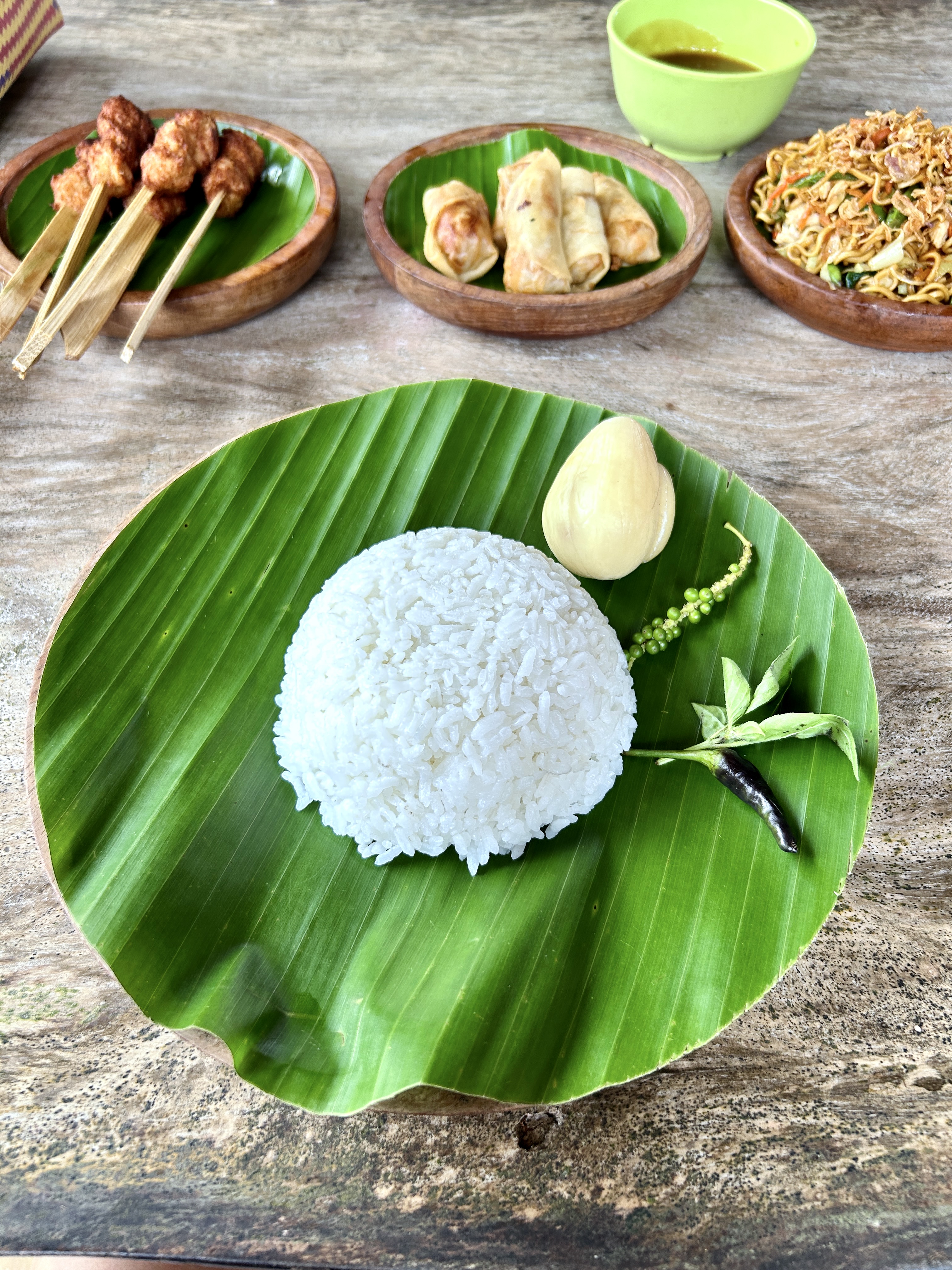
When the food came out, she said something I didn't fully catch, something about home-style cooking, eat as much as you want. Wooden plates arrived with banana leaves. Saté on lemongrass skewers. Stir-fried greens with grated coconut. Spring rolls, golden and crisp. Fried noodles heaped with crispy shallots. Rice, plain and generous, at the center of everything. There was no menu. There had never been a menu. You ate what the kitchen made, and the kitchen made what the family ate. It was the closest thing to a home-cooked meal I'd had on the trip. They'd set a separate table for us, away from the others, because we could handle heat and the other guests couldn't. They seemed genuinely pleased about it, happy to do the extra work of making everything properly spicy for people who actually wanted it that way.

The next day, after a waterfall and a winding road, my driver offered me a choice: good view with Western food, or authentic Indonesian home cooking. I chose the second without hesitating, something from the day before still in me, some residue of the mountain, the wooden bowls, the woman's smile. The village felt like that too. Small, unhurried, everyone familiar with everyone else. On the way, my driver pointed out his house in passing. His dog was at the gate, wagging its tail. He waved without slowing down. He seemed to know everyone along that road, every house, every restaurant. It was probably why he'd recommended the one we were headed to.
The restaurant, if you could call it that, had no menu either. A soup came first: clear broth, winter melon, kernels of corn, fried shallots floating at the rim. Then a banana leaf arrived. Rice mounded at the center, topped with a small crown of serundeng, fried coconut flakes I was starting to recognize. Around it: corn fritters, braised chicken dark with spice, quick-pickled vegetables, a sate skewer tucked at the edge like a signature.
The man who brought it said something as he set it down. He gestured at the leaf, at everything arranged around the rice, and said the name.
"Jjamppur. Nasi jjamppur," he said. "Jjamppur means mixed. Nasi means rice. Mixed rice." That was the moment I realized I'd been reading it wrong all along.
I had seen those words a hundred times on warung signs along every road in Bali, painted in sun-faded letters, read and absorbed without being heard. I had read it as text. I had never heard anyone say it aloud.

Suddenly I realized I already knew the word. I just didn't know I knew it.
Jjamppong (짬뽕) is a word I grew up using to mean something thrown together, combined, not quite one thing or another. It's also a name of my favorite Korean noodle soup, fiercely red, full of seafood and heat. I had read somewhere that the word itself had traveled: from a Malay root, through Japan, into Korean, each language giving it a slightly different shape. I understood that in theory. It didn't quite land.
Then a man in Bali said campur, and something that had been sitting at a distance suddenly arrived. The word I thought I knew turned out to have come from somewhere I was standing. Words travel the way dishes do, changing shape in other mouths, arriving somewhere new and becoming the only name anyone uses, until nobody remembers the journey.
The dessert was two green crêpes rolled tight, pandan-colored, filled with sweet grated coconut. Alongside them, fried banana caramelized at the edges. Both on a banana leaf, naturally. I'm not someone who eats sweets easily. I ate all of it.

On the warung signs I had passed a hundred times, Nasi Campur was still painted in the same faded letters. But I could not read it the same way again. Some words you see for years before you finally hear them. And when you hear them, really hear them, in someone's mouth, over a banana leaf, in a language you are only beginning to touch, the word stops being a sign.
It becomes a door.
One More Thing:
The composition and structure of nasi campur got me thinking. Korean has an exact word for this: bibimbap (비빔밥). Bap is rice. Bibim is mixed. A bowl with rice at the center, vegetables and meat arranged around it, a thread of gochujang, everything separate until the moment you choose to bring it together. The composition is the point. The coexistence is the cooking. You could translate nasi campur and bibimbap into each other almost word for word and end up with the same meal, made by people who never met, on opposite sides of a very large ocean.