Shared Flavors , Shared Memories
Fish From Distant Waters
Every summer at Lake Balaton, the first thing we eat is hekk: a fish from Argentina, frozen and shipped across thousands of kilometers, that somehow became the taste of a Hungarian summer.
Every summer at Lake Balaton, the first thing we eat is hekk: a fish from Argentina, frozen and shipped across thousands of kilometers, that somehow became the taste of a Hungarian summer.

Every summer, Budapest empties. People head to Lake Balaton, and we used to join the migration each year, looking forward to it long before the season arrived. Certain foods belong to that place. They announce the start of summer as clearly as the heat does.
Along the shore, small stands sell hekk, fried fish served alongside lángos. As soon as we arrived, the unpacking could wait. The first order of business was always the same: lángos, beer, and hekk. The fish arrives battered and fried whole, about twenty to thirty centimeters long, crisp on the outside, bones and all. While lángos appears throughout Hungary even in the cities, hekk is rarely seen anywhere else. Somehow it belongs only to Balaton, only to summer.

What makes this funnier is that the fish itself is not from Hungary at all. Hekk arrives frozen in boxes from the South Atlantic, near Argentina. Hungary is landlocked, the fish reaches the lake through international trade, shipped across thousands of kilometers. And yet it settled so completely into the rhythm of summer there that nobody thinks about where it came from. The distance disappeared.
Thinking about hekk brought back a memory from a completely different road.
On the way to Sokcho as a child, we would cross Hangyeryeong (한계령), one of the highest mountain passes before reaching the coast. The pass is cold even in winter, and along the road I remember seeing long rows of fish hanging in the open air, hwangtae-deokjang (황태덕장), drying racks where pollock are left through cycles of freezing nights and thawing days. The resulting fish, hwangtae (황태), has a texture entirely different from the regular dried version. The mountain cold does something to it that no other process replicates.
Myeongtae (명태), Alaska pollock, was once so central to Korean food that it carried a nickname: gukmin-saengseon (국민생선), the national fish. The same fish appears across Korean cooking under different names depending on how it is prepared: frozen, semi-dried, fully dried, young and small, each state with its own identity and use. Almost nothing is wasted. Even the roe becomes myeongnan-jeot (명란젓), the preserved fish roe that appears on the everyday table. I grew up eating many forms of it without thinking of them as variations on the same creature. Myeongtae was simply everywhere.
What I learned later sat uneasily. Pollock populations around Korea collapsed after years of overfishing, and today much of the fish is imported from Russia and the United States before being prepared and sold as a Korean ingredient. Korea has a particular cultural sensitivity about suipsan (수입산), imported products, and yet the national fish quietly depends on distant waters. The drying racks on the mountain pass looked timeless. The fish hanging in them had often traveled a long way to get there.
I think about this now when I visit the fish shop in the Netherlands.
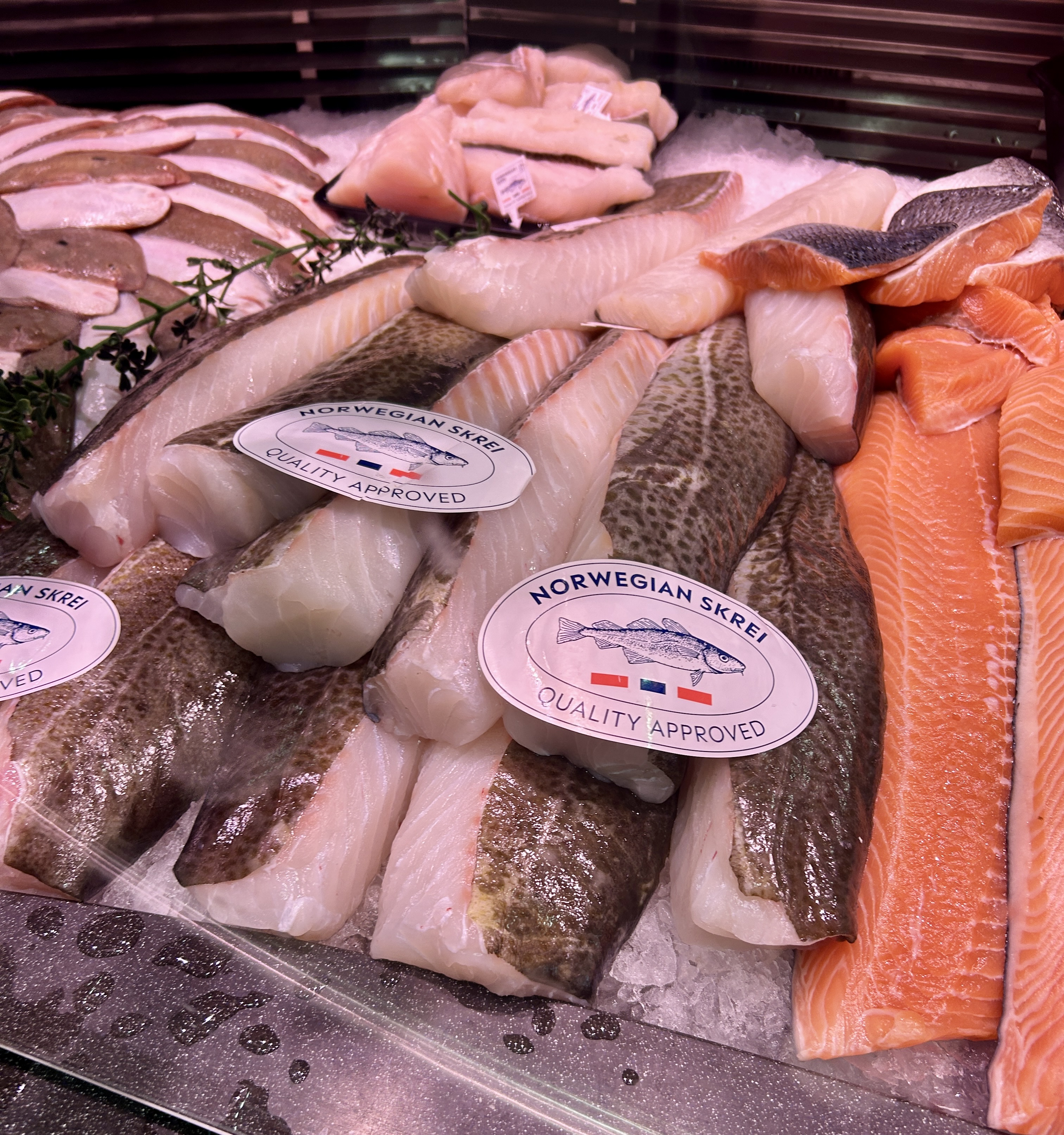
Kabeljauw (dutch name for cod) sits at the center of the display, especially the seasonal Skrei from Norwegian waters, prized for its firm white flesh. Near it, often quieter and cheaper, is koolvis, pollock, literally "coal fish," named for its darker color. In the Netherlands it fills fillets and fish sticks, used practically, rarely celebrated.
In Korea the same fish would be treated entirely differently: named carefully, prepared in multiple forms, preserved in parts, considered a comfort. To me the taste of the two fish is not so different, both mild, both versatile. If anything I may prefer myeongtae. But I grew up in a place where pollock meant everyday warmth, something ladled into soup on ordinary evenings. Here it means something humbler still.
The same fish, caught in the same cold northern waters, arrives at two tables with different reputations entirely. Hungary's hekk traveled from Argentina to become summer. Korea's national fish now travels from Russian or Alaskan waters to reach a table where it is still treated as home. The distance is part of the food now, whether we think about it or not.