Shared Flavors , Shared Memories
In the Time of Bear’s Onion
A fleeting spring leaf links Hungary and Korea, and carries a story of survival, memory, and joy across two kitchens.
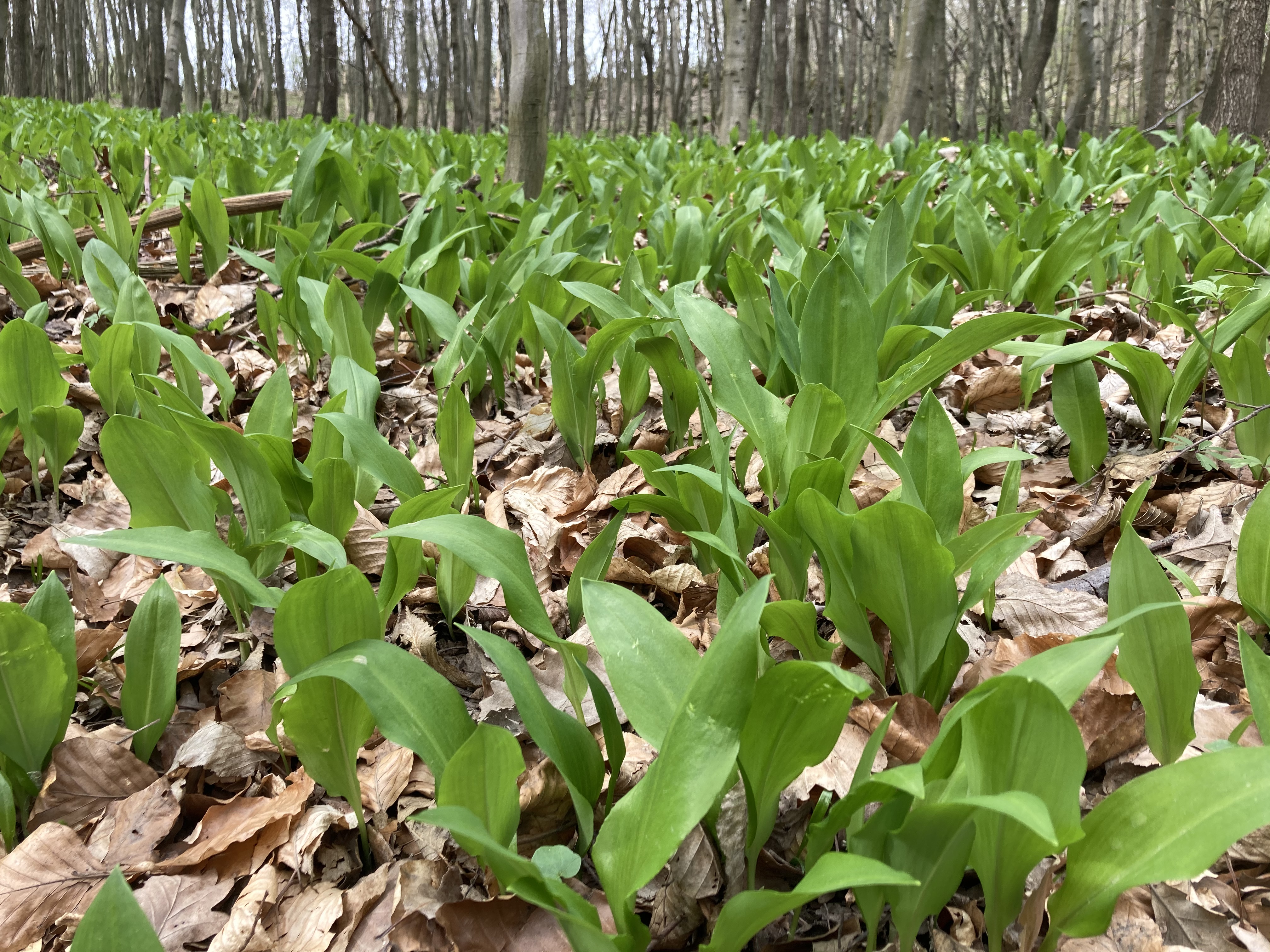
A fleeting spring leaf links Hungary and Korea, and carries a story of survival, memory, and joy across two kitchens.

Medvehagyma arrives quietly each spring. Delicate, garlicky, and vividly green, it appears in Hungarian markets for only a short window each year. If you blink, you might miss it.
In English, it's called bear's onion.
The first time I tasted it, my husband chopped it like parsley and sprinkled it over főzelék, a thick Hungarian vegetable stew. The leaves added freshness, a gentle bite, and a splash of color. Simple, but striking. I had never seen anything quite like it before moving to Hungary.
Curious, I looked up its name in other languages. I have a habit of doing that with ingredients that surprise me. Learning what something is called elsewhere feels like tracing quiet lines between cultures.
To my delight, I discovered that bear's onion is known in Korea as myeonginamul (명이나물). The name sounded familiar. When I asked my mother about it, her eyes lit up.
In Korea, she told me, it's considered a delicacy. It grows wild on Ulleungdo (울릉도), a remote island in the East Sea, and is often preserved in soy sauce or prepared like kimchi. It's served as banchan alongside samgyupsal. Its sharp, soy-cured bite cuts through the richness of the meat.
When I shared this with my husband, he mentioned casually that not far from where we lived, there are entire fields of medvehagyma. I felt as if I had stumbled onto something hidden. It brought back a childhood thrill, the feeling of collecting chestnuts still warm inside their spiky shells. I found myself in the same focused rhythm, gathering bouquets of bear's onion.

I began wondering why it is called bear's onion at all.
The plant grows wild across Europe and parts of Asia, and is one of the first greens to emerge after winter. Bears are said to eat it after hibernation to cleanse and revive their bodies. Hence the name.
That detail stayed with me, because in Korea one of our oldest stories also begins with a bear and garlic. In the myth, a bear and a tiger longed to become human. A heavenly being gave them a task: remain inside a dark cave for one hundred days, eating only garlic and mugwort. The tiger gave up. The bear endured. She became Ungnyeo, the bear-woman, who later gave birth to Dangun, the founder of the first Korean kingdom.
A plant that wakes bears. A myth that transforms one.
The Korean name carries layered meanings too. One interpretation links myeonginamul to "bright ears," suggesting the plant sharpens hearing. Another connects it to survival. During lean spring months on Ulleungdo, when little else would grow, this wild herb helped people endure. In that sense, the name means something closer to "the life-sustaining herb."
What began as a seasonal curiosity slowly became something else. Discovering myeonginamul opened a quiet passage between my life in Hungary and my roots in Korea. My parents sent recipes. I listened, took notes, and adjusted.
The leaves are usually prepared simply. Muchim (무침): blanched, lightly dressed with soy sauce and sesame oil. Geotjeori (겉절이): eaten fresh, seasoned with gochugaru. And for longer keeping, jangajji (장아찌): stacked and soaked in soy brine so they last for months.
Each method extends something that would otherwise vanish quickly.
Now, miles from Ulleungdo, I walk through Hungarian fields thick with medvehagyma. The plant is abundant here, ordinary even. Yet when I stack the leaves carefully into jars of soy brine, I feel the distance shift.
The same leaf carries two names. Two sets of stories. Two kitchens.
It appears briefly, then disappears again, reminding me that some things are meant to be gathered while they can. Perhaps that is why we preserve it so carefully. Not only to keep the flavor, but to hold onto the moment when it connects one place to another.
Jó étvágyat.