Shared Flavors , Shared Memories
The Best Cake in the World
My mom made gimbap look easy. It wasn't. I only understood that after years of trying to roll it myself.
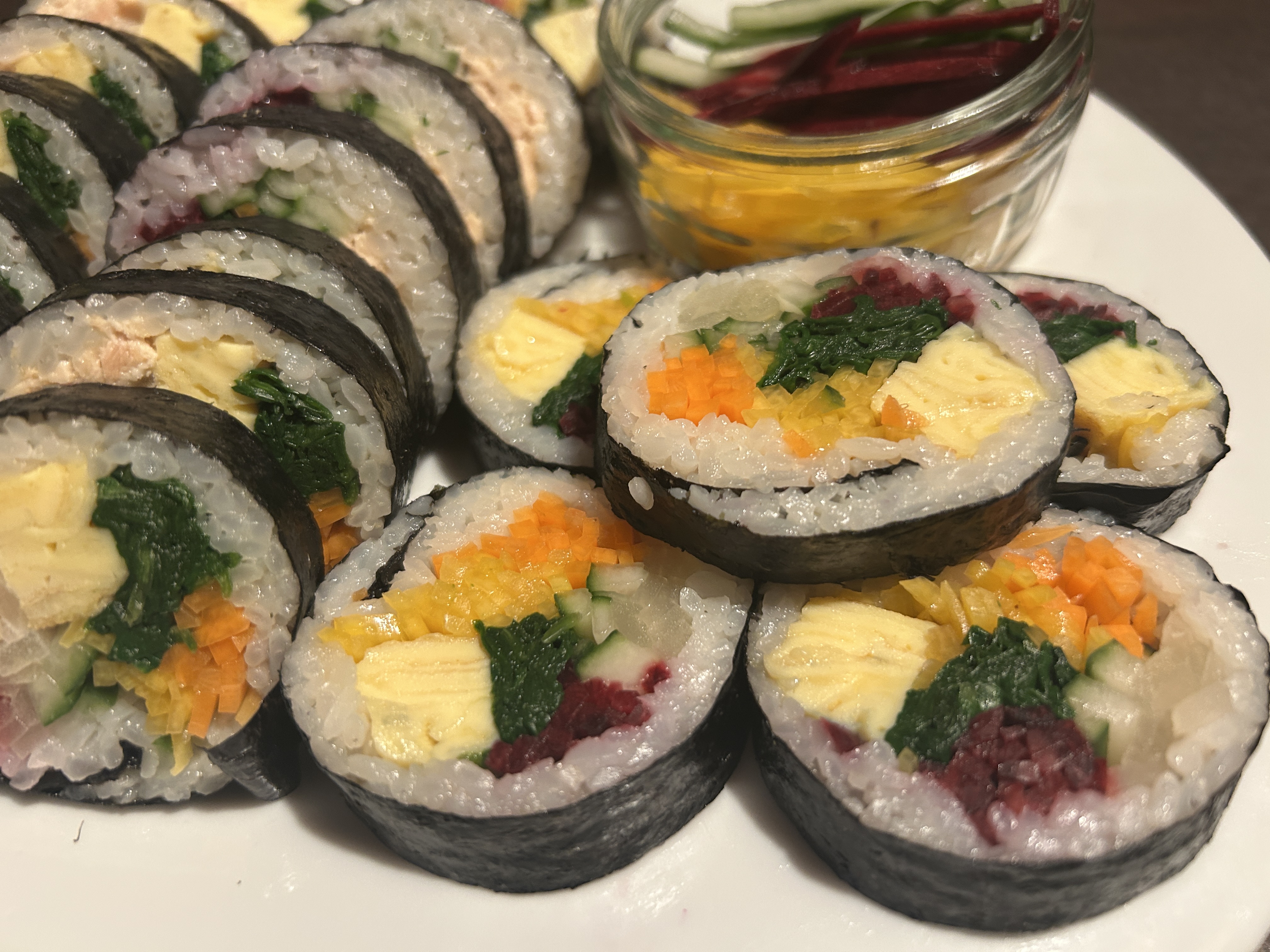
My mom made gimbap look easy. It wasn't. I only understood that after years of trying to roll it myself.

On school trip days, I woke early, already excited. Even before I opened my eyes, I could hear clinking sounds from the kitchen. My mom had started early in the morning, still dark outside, everything still sleeping; she moved carefully, trying not to wake anyone. The hiss of steam from the pressure cooker echoed through the house, the scent of freshly cooked rice and chamgireum (참기름), thick and nutty, filling the air. She'd prepared most of the fillings the day before: ham, odeng, danmuji, spinach, carrots, sliced into long strips. A few things had to wait until that morning, like the pickled cucumber, which couldn't sit overnight or the color would change. Everything mapped out in her head, I bet she couldn't have slept well, running through what was done, what still needed doing.
On days like this, she put in extra effort making our dosirak (도시락), our lunchbox. It had to stand out among the many others filled with gimbap (김밥), make us feel proud. For school trips, gimbap was the unspoken rule, and I don't just mean my family. I mean every Korean household. You'd stand out if you didn't bring it. I was lucky. I know gimbap wasn't always a happy memory for everyone.
By the time she finished rolling, my brother and I were already hovering nearby. Dozens of freshly rolled gimbap, chamgireum-coated, shined, stacked up neatly. We watched her slice and arrange the pieces neatly in the lunchbox, adjusting the rows, adding small garnishes so everything looked just right, ready to impress when opened. And then came the best part: the kkodari (꼬다리), the end pieces, eaten straight from the cutting board. A little uneven, heavier on the fillings, like the crispy corner of a lasagna pan, the part that never gets plated, but everyone would fight over. They weren't pretty enough for the lunchbox; lucky for us, they became our instant breakfast. Worried that gimbap alone can be dry (the unwritten rule that soup always accompanies rice, and gimbap being no exception), she'd somehow also managed to make gyeran-guk (계란국) in that same stretch of time. She's well known in our family for that kind of multitasking, as if she had a magic wand, things just appearing in her kitchen out of nowhere. But I'm sure she'd planned it all the night before, rehearsing the steps she'd need in the morning, wide awake while the rest of us slept.
My good memories of gimbap probably meant many sleepless nights for my mother. It wasn't an everyday food, it took orchestrated effort to make the next day look effortless. An occasion made even more special. My earliest memory of gimbap came in an unexpected form: a cake, three round layers, stacked neatly. My mom, ever creative and handy, turned gimbap into a birthday cake. She tied it with ribbons, pretty enough to look festive, functional enough to hold everything together, untying it in place of blowing out candles. It was the kind of creativity that would've made a perfect Instagram photo. I'm still not sure where she got the idea, though. Maybe it was because I never liked buttercream cakes with a fake cherry on top. Or maybe we just loved gimbap enough, and cared little for sweets, that it made perfect sense. Either way, the gimbap cake was special, and it lives in my memory to this day, along with the miyeok-guk (미역국), seaweed soup that showed up every birthday morning without fail. I never realized how precious it was to have it every year until it stopped showing up on my birthdays.

These days, though, you no longer need an occasion to eat gimbap. It has become something you buy from a convenience store or one of the gimbap specialty chains like Gimbap Cheonguk (literally, "gimbap heaven"), which sells pre-made rolls for cheonwon (about a dollar). Wrapped in foil and ready for people rushing to work to peel back little by little as they walk and eat. The stay-at-home moms who used to make gimbap at home are now more likely to have a day job at a gimbap restaurant. Gimbap takes a lot of prep, and it doesn’t really make economic sense to make it at home for just one roll. Most Koreans have a preferred gimbap chain or two. My mom has one too (but I still like hers best, if I add a little lie, and that's not entirely a lie at all).
It makes sense, if you think about it, why gimbap became this popular. Unlike most Korean foods that require a spoon, chopsticks, and a bowl of rice on the table, gimbap asks for none of that. It offers that same convenience, something you can eat with your hands, on the go, like burgers, but still with rice and banchan built into every bite. That's likely why it worked so well for kids' dosirak too: bite-sized, portable, many different banchan folded into one. No need for fancy chopstick skills yet. The perfect solution for a fussy eater who wouldn't touch their vegetables otherwise.
Still, in the early days of living abroad, gimbap was far from convenient for me. I didn't have the luxury of picking one up on the way. The closest thing might have been a breakfast taco wrapped in foil, grabbed from a drive-through at Taco Cabana. Nor did I have my mom around to make one for me the way she used to. So whenever the craving hit, there was only one solution left: make my own. I remember thinking it shouldn’t be that difficult, and it didn’t take long to understand why people buy it instead of making it themselves.
I'd watched my mom roll gimbap so many times growing up, and she always made it look easy. Most of the time, I caught her only at the very end, right as she was about to slice. I never got to see the whole process from start to finish in one go: prepping the rice and fillings, rolling, and finally slicing.
The first step, the preparation, is probably the most important in determining the taste of gimbap. The rice needs slightly less water than usual, mixed with chamgireum and a bit of salt, done ever so gently that the grain stays alive, never mashed, using the edges of the jugeok (주걱) rather than the wide surface to press down. That's the first place it can go wrong. Each filling gets prepared on its own, so nothing loses its own texture or flavor before it even makes it into the roll.
Then comes the rolling. Rice spread evenly, by hand, grain by grain, without leaving any spot uncovered, using just enough pressure so that the grain stays alive here too, never pressed into paste like tteok. Filling portioned just right: not so loose that the rice-to-filling ratio stays balanced, and not so full that it splits the roll open. Gimbap rolls have to rest, just like a steak has to rest a little before serving, so that the gim (김) gets a bit of chamgireum and moisture, softens enough, and forms that thick covering that holds the rice tight before slicing.
And finally, the highlight: slicing. My earliest attempts look a little sad in photos. I had no idea it required its own technique. You want to wet the knife a little so the rice doesn't stick, and use it like a saw, gently, front and back, so the filling stays intact. Too much pressure and you get to hear 'the sound of gimbap's side bursting,' a phrase describing nonsense, since of course it makes no sound at all.
After countless failed attempts, each one a little better than the last, I'm sure she wasn't perfect at first either. My mom never had the luxury of someone making gimbap for her. I don't think her own mother ever made a dosirak alone. A gimbap cake was a luxury. But she gave it to us anyway, every single time, without ever having had it given to her first. I'm only now starting to see the size of that.
Waking early in the morning, still dark, careful not to wake anyone, not until she was almost ready to slice, until my brother and I hovered around, picking up pieces as she began packing dosirak. I still miss those mornings, greatly.
Now that so many Korean restaurants are popping up in the neighborhood I live in, I have options. I can pick up gimbap, and I don't have to roll it myself anymore. But I still do, for an occasion: a dinner party, a neighborhood potluck, or a Sunday afternoon when I simply want it (because, to this day, I still can't get behind the idea of eating frozen gimbap). As I get ready to slice, my husband hovers nearby, picking up that end piece. It's not pretty enough to make it onto the plate, and he knows, like we did, it's the best part.