Shared Flavors , Shared Memories
Around the Grill: Samgyeopsal (삼겹살)

More than pork belly, samgyeopsal is about time, heat, and the way a table pulls people together.
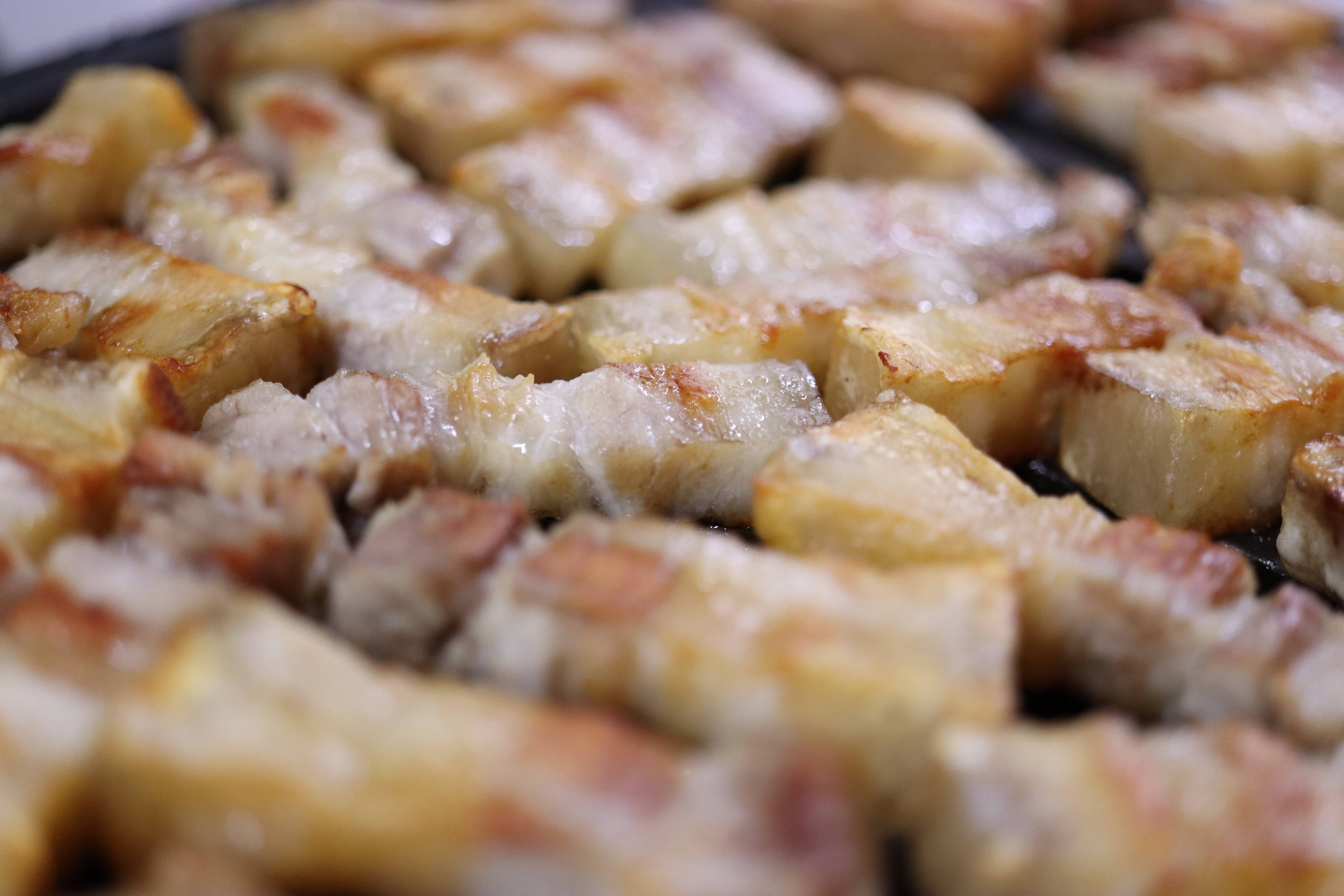
Newspaper on the Floor, Samgyeopsal Day

When I think of samgyupsal (삼겹살) from my childhood, the first thing that comes to mind isn’t the meat itself. It’s the newspaper spread across the floor, the hiss of fat hitting hot metal, the smell that lingered long after the meal ended. Samgyeopsal wasn’t something we ate casually. Meat wasn’t common then, maybe once or twice a week. When pork belly appeared, it felt earned.

I remember asking for it plainly, almost like a wish:엄마, 나 고기 먹고 싶어.

“Mommy, I want to eat meat.”

It wasn’t just hunger. It was asking for something special, something that required planning. Once the decision was made, the whole house shifted. My father laid newspaper on the floor and set the portable gas burner in the center. My mother prepared side dishes. I washed lettuce, sliced garlic, hovered nearby. Everyone had a role, even if it was small. Samgyeopsal wasn’t just cooked. It was assembled by the people who were about to eat it together.

Eating on the floor wasn’t nostalgic or decorative. It was practical. Grease splattered, smoke filled the room, and the newspaper caught everything. When the meal was over, it was folded up and thrown away, carrying the evidence of the night with it. Sitting on the floor brought everyone closer. There was no head of the table, no distance. Just heat, shared space, and the feeling that this wasn’t everyday food, but an occasion.

Now, that scene feels almost unfamiliar. Samgyeopsal is usually eaten outside, at restaurants with built-in grills and proper ventilation, designed to keep the smoke and mess at a distance.
Samgyeopsal, Grilled Into Center Stage

Koreans really love samgyeopsal. That much is obvious. But it’s worth asking why this particular cut became the meat people gather around.

For a long time, the answer was practical. Beef was expensive and still is. Pork was cheaper, and samgyeopsal was cheaper still, often considered too fatty and less desirable than leaner cuts. As Korea’s economy grew through the 1970s and 80s, meat consumption increased. Pork production improved, feed quality rose, and boar taint was gradually reduced. Samgyeopsal became easier to enjoy.

But availability alone doesn’t explain its rise. The real turning point was gogi-gui (고기구이), tabletop grilling.

Before that, pork was more often chopped, stewed, or mixed into dishes. Thick slices of pork belly weren’t commonly grilled. With the spread of portable gas burners like the buruseuta (부루스타) and improved ventilation in restaurants, samgyeopsal became ideal for direct grilling. Fat rendered slowly, flavors intensified, and cooking became part of the meal itself. The grill moved to the center, and samgyeopsal moved with it.

What was once an overlooked cut became something people actively craved. Not just because it was affordable, but because it worked so well for grilling together.

Over time, its role changed again. Samgyeopsal is no longer inexpensive. Prices now vary by origin, thickness, and quality. People distinguish between domestic and imported pork, specific farms, and even feeding practices. What used to be everyday meat became something people compare, debate, and sometimes save up for.

As that shift happened, curiosity expanded beyond pork belly itself. Restaurants began offering different variations and specialty cuts like galmaegisal (갈매기살) and hangjungsal (항정살). Scarcity gave way to exploration.

Yet the structure stayed the same. The grill is still in the middle. People still cook together. What changed wasn’t the ritual, but the range of what could be placed on the heat.

Assorted raw pork cuts for Korean gogi-gui, including sliced pork belly and other grilling cuts arranged in different thicknesses and shapes.
Various cuts of pork prepared for gogi-gui, sliced and shaped to cook quickly over direct heat. Images sourced from the internet

Assembled and Paired

Samgyeopsal is designed to be eaten with minimal tools and maximum participation. At the table, you’ll usually find tongs and scissors instead of knives and forks. Thick slabs of pork are placed directly on the grill, cut as they cook, then trimmed again into bite-sized pieces. The cutting happens in real time, in front of everyone. It’s not sloppy. It’s efficient, and it keeps everyone involved.

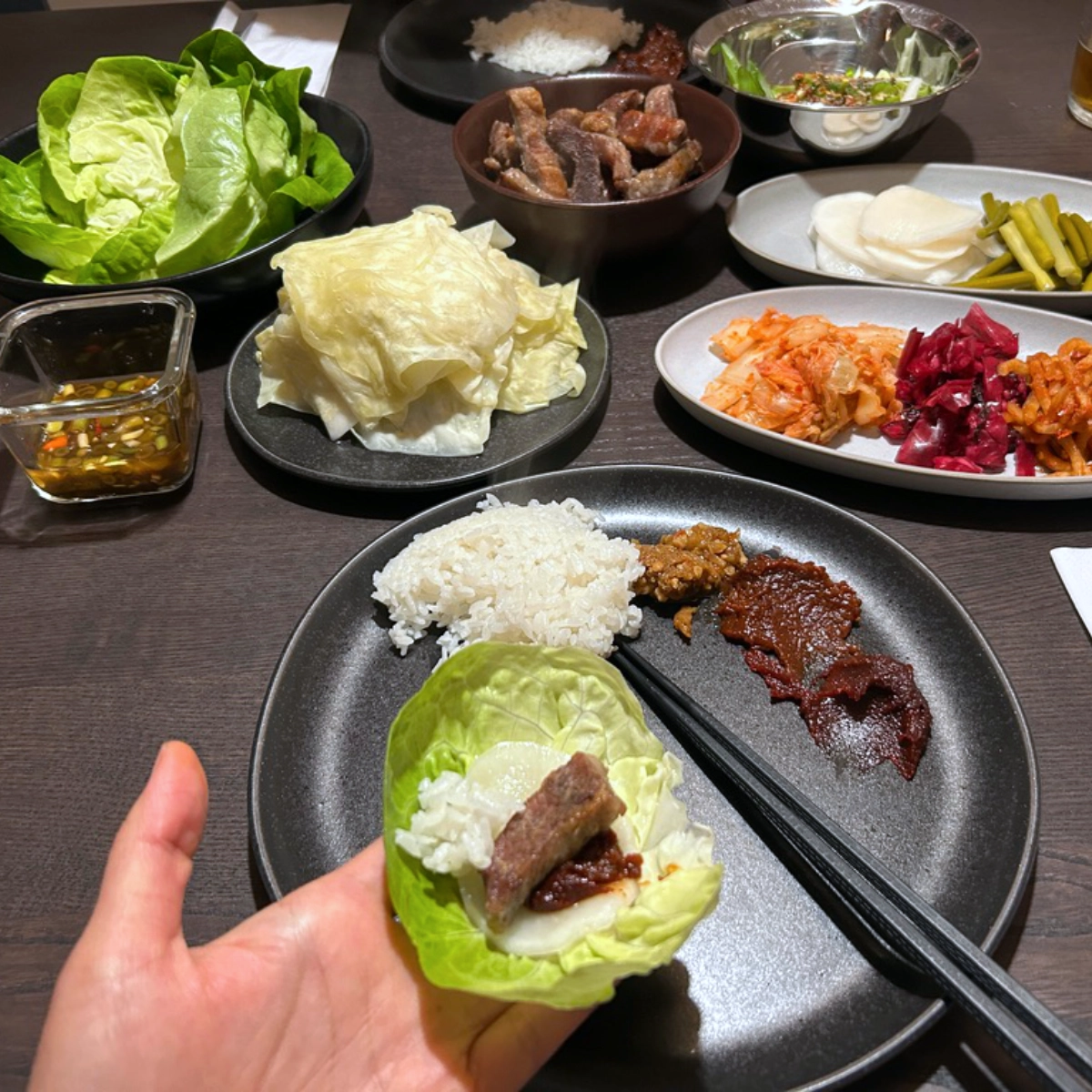
Once cooked, the eating is hands-on. Each bite is made as ssam (쌈). A piece of pork goes onto lettuce or perilla leaf, followed by garlic, chili, ssamjang (쌈장), maybe a bit of kimchi (김치) or myunginamul (명이나물). The wrap is folded quickly and eaten in one bite. Chopsticks help, but hands do most of the work. There’s no plating, no individual portions. Everyone reaches, cuts, wraps, and eats together. You don’t receive a finished dish. You build each bite yourself.
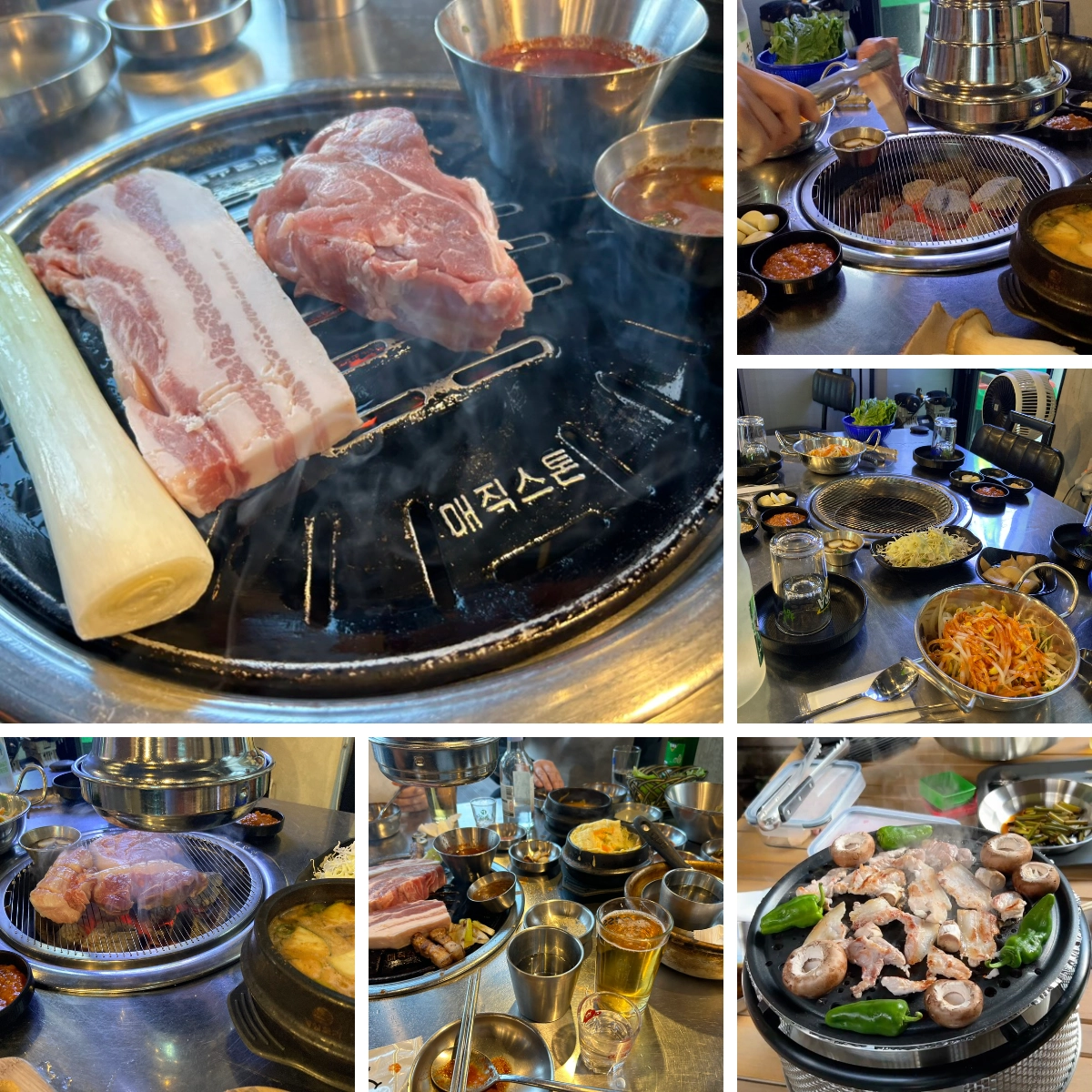
The meal doesn’t end with meat alone. Traditionally, samgyeopsal is followed by husik (후식) , not dessert in the Western sense, but a closing course to settle the stomach. That might be rice with kimchijjigae (김치찌개) or doenjangjjigae (된장찌개) , naengmyeon (냉면), or one of my favorites, bokkeumbap (볶음밥) cooked directly on the grill with leftover fat and scraps. The sequence matters. Meat first, then something warm or starchy to bring the meal to a close.

Slices of pork belly and vegetables grilling on a tabletop charcoal grill, surrounded by metal bowls, side dishes, and drinks in a Korean restaurant.
Samgyeopsal cooking at the table, pork and vegetables sizzling over charcoal while side dishes and drinks fill the space around the grill. Photo by the author

This structure is what makes soju (소주) fit so naturally. Samgyeopsal is fatty, salty, and hot straight from the grill. Each bite is rich and heavy. Soju cuts through that. It’s clean, neutral, and cold, resetting your mouth after every ssam. As soju became more commercialized and its alcohol content lowered over time, the pairing became easier and longer. You could drink slowly, eat deliberately, and stay at the table without rushing.

More than flavor, soju reinforces the rhythm of the meal. You grill a little, eat a little, pour for one another, talk, then repeat. Drinking follows the food, not the other way around. The meat sets the pace. The soju keeps time. It’s not about getting drunk quickly. It’s about staying together longer, letting the night unfold one bite and one glass at a time.

Samgyeopsal Abroad

The first time I cooked samgyeopsal in the Netherlands, I was taken aback by the smell. The pork looked beautiful, but once it hit the heat, a strong odor emerged. I learned the term the hard way: boar taint. Male pigs that aren’t castrated can develop it, and castration is restricted there for animal welfare reasons. What had once been an intuitive purchase suddenly felt uncertain.

Cooking samgyeopsal turned into research. I learned to ask questions, to seek out butcher shops instead of supermarkets, to look for female pork specifically. I learned which cuts worked, which didn’t, and how thickness changed everything.

Migration made me pay attention in a new way. What used to be automatic now required understanding local farming practices, supply chains, and compromises. Samgyeopsal didn’t disappear from my table, but it changed. And in adapting it, I realized how much knowledge had once been quietly built into the way we cooked back home.

These days, my samgyeopsal table looks different. The floor is clean, no newspapers.  What hasn’t changed is the ritual. The table still needs to be ready before the meat hits the heat.

The roles shift depending on who’s there. Sometimes I’m the one grilling, sometimes not. Someone washes and dries the lettuce. Someone mixes the pamuchim (파무침). Kimchi comes out early. Rice waits until the end. Even when it’s just two people, the meal asks for coordination. Samgyeopsal still isn’t something you rush or eat absentmindedly. It still pulls everyone into the same rhythm.

A hand holding a lettuce wrap filled with pork, rice, and sauce, with side dishes, kimchi, and condiments spread across a Korean barbecue table.
A samgyeopsal table mid-meal, wraps, known as ssam, built one by one with pork, rice, and condiments, while the rest waits within reach. Photo by the author

What It Means to Eat Samgyeopsal

Once you start paying attention, you notice that the instinct behind samgyeopsal isn’t unique. In Hungary, there’s szalonnasütés , where thick slabs of pork fat are grilled over open fire at block parties or gatherings. People take turns tending the heat, slicing, passing pieces around. It isn’t refined, but it’s deliberate. The food asks people to stay close and stay involved.

I don’t think these practices are the same, and I don’t want to flatten them into one idea. Samgyeopsal is specific to Korea, shaped by its history, economy, and habits. But the pull toward fat, fire, and shared timing feels familiar across places. Braai, Sunday roast, barbecue, fajitas, asado. When meat is grilled together, eating slows down. Pauses appear. The meal becomes less about efficiency and more about presence.

When I think back to samgyeopsal now, I don’t picture a restaurant grill or a perfect cut of meat. I see newspaper spread across the floor, the hiss of fat hitting hot metal, people moving around each other without needing to be told what to do.

The tools have changed. The price has changed. The setting has changed. But the structure hasn’t. Samgyeopsal still asks for time, attention, and participation. It still works best when no one eats alone.

That’s what stayed with me. Not just how we cooked it, but how it made us sit longer, talk more, and share the work of the meal. Even now, wherever I am, that rhythm feels familiar.